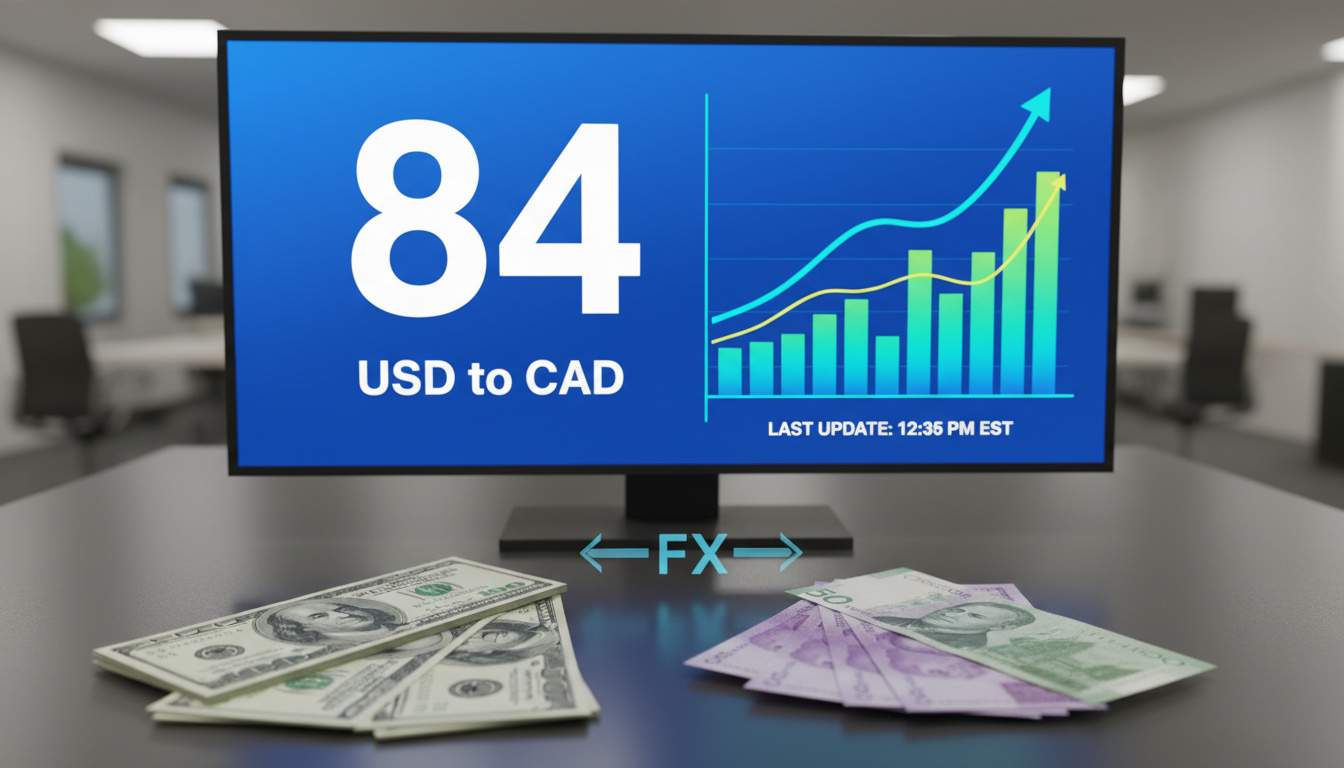

Converting 84 United States dollars to Canadian currency yields approximately 116.86 to 120.72 CAD, depending on the specific exchange rate source and timestamp consulted. The USD/CAD pair trades continuously across global foreign exchange markets, with values shifting in response to central bank policies, commodity price movements, and macroeconomic data releases. Understanding the precise conversion requires examining real-time mid-market rates alongside the broader volatility context that has characterized recent months.
Spot rates for the currency pair have fluctuated between 1.391 and 1.437 Canadian dollars per US dollar during early April 2026. This spread of nearly four cents demonstrates why travelers, cross-border shoppers, and remittance senders must verify current quotes rather than rely on static calculations. Financial institutions apply varying margins above these baseline figures, further affecting the final amount received.
What is 84 USD to CAD Today?
| Current Rate Range 1.391 – 1.437 CAD per USD |
84 USD Value 116.86 – 120.72 CAD |
24h Movement Fluctuating within 1.37–1.44 band |
Last Updated April 3, 2026 |
- Mid-market rates exclude bank fees and provider margins, which typically reduce received amounts by 1–3%.
- At the upper bound of 1.43740, 84 USD converts to exactly 120.72 CAD according to Wise mid-market data.
- The lower bound of 1.39114 yields 116.86 CAD based on XE closing rates.
- Rate differentials between providers create a spread exceeding 3.80 CAD on identical 84 USD amounts.
- Historical 12-month averages hover near 1.4001, positioning current rates slightly above long-term means.
- Oil price volatility remains a primary driver of CAD strength given Canada’s commodity-exporting economy.
- Interest rate differentials between the Federal Reserve and Bank of Canada currently favor USD valuation.
| Amount (USD) | Rate Source | Equivalent (CAD) | Timestamp |
|---|---|---|---|
| 84 | XE.com | 116.86 | Close 1.39114 |
| 84 | Exchange-Rates.org | 116.93 | April 3, 2026, 10:00 AM UTC |
| 84 | Revolut | 117.57 | Rate 1.39960 |
| 84 | Wise | 120.72 | Mid-market 1.43740 |
| 84 | 30-Day Average | 120.12 | 1.4300 baseline |
| 84 | 90-Day Average | 120.52 | 1.4348 baseline |
| 84 | 12-Month Average | 117.61 | 1.4001 baseline |
Current USD to CAD Exchange Rate
Mid-Market Definitions and Source Variations
The term “mid-market” refers to the midpoint between the bid and ask prices in global currency markets. Data from Exchange-Rates.org captured on April 3, 2026, at 10:00 AM UTC establishes one baseline, while concurrent readings from other platforms show divergent figures. These variations arise from different liquidity providers, update frequencies, and geographic trading sessions.
Retail banks and money transfer services rarely offer the mid-market rate directly. Instead, they incorporate spreads that compensate for operational risk and profit margins. Consequently, an individual exchanging 84 USD at a retail location may receive significantly less than the 116.93 to 120.72 CAD range indicated by raw market data.
The rates quoted for 84 USD to CAD represent wholesale values between banks. Consumer-facing institutions typically apply margins of 1–3% above these figures, meaning the actual received amount may be reduced by 1.17 to 3.62 CAD on an 84 USD conversion.
Real-Time Data Providers
Multiple platforms track USD/CAD movements instantaneously. Wise publishes mid-market rates updated by the second, while Revolut maintains historical archives showing recent fluctuations. XE.com provides charting tools that visualize intraday volatility, helping users identify optimal conversion windows.
What is 84 CAD to USD?
Calculating the Inverse Conversion
Reversing the calculation, 84 Canadian dollars convert to approximately 58.46 to 60.35 USD based on prevailing exchange rates. Using the inverse of the 1.43740 rate yields 58.46 USD, while the 1.39114 rate produces 60.35 USD. This asymmetry highlights how currency pair notation affects perceived value, with the CAD maintaining a weaker position relative to the USD throughout recent trading sessions.
Value Comparison Points
The inverse rate serves travelers purchasing American goods with Canadian funds and investors repatriating CAD-denominated earnings. Historical charts from XE reveal that the purchasing power of 84 CAD has declined slightly against the USD over the past 90 days as the American currency strengthened by 1.58%.
USD CAD Historical Chart and Trends
Over the past year, USD/CAD reached a peak of 1.4543 on January 31, 2025, and a trough of 1.3573 on June 16, 2025. This 7-cent spread demonstrates significant volatility, with the pair averaging 1.4001 and posting an overall gain of 1.77% for the US dollar according to Exchange-Rates.org annual data.
Monthly averages tracked by OFX illustrate a declining trend from late 2025 through early 2026. October 2025 registered 1.39949, November 1.40505, and December 1.3786. The new year brought further CAD strength with January 2026 averaging 1.377931, February bottoming at 1.365178, and March recovering slightly to 1.372518. Recent daily data from Investing.com shows minor swings between 1.3724 and 1.3756 with percentage changes ranging from -0.20% to +0.50%.
While short-term forecasts suggest continued USD strength based on current interest rate differentials, long-term projections remain dependent on oil market recovery and potential policy shifts by the Federal Reserve or Bank of Canada. No specific 2026 targets have been established in available institutional forecasts.
How Has the USD to CAD Rate Changed Over Time?
- : Rate achieves 12-month high of 1.4543 — Exchange-Rates.org
- : Rate drops to 12-month low of 1.3573 — Exchange-Rates.org
- : Monthly average stabilizes at 1.39949 — OFX
- : Year-end average falls to 1.3786 — OFX
- : Average declines to 1.377931 — OFX
- : Monthly average reaches 1.365178 — OFX
- : Slight recovery to 1.372518 average — OFX
- : Current trading range established between 1.391 and 1.437 — Exchange-Rates.org, Wise
What is Certain About Today’s 84 USD to CAD Conversion?
| Established Information | Information That Remains Unclear |
|---|---|
| 84 USD converts to between 116.86 and 120.72 CAD based on verified mid-market rates from April 2026 | Precise timing of future Bank of Canada or Federal Reserve policy shifts that could move rates beyond current bands |
| The USD has strengthened approximately 1.77% against the CAD over the past 12 months | Exact exchange rate at the moment of a specific retail transaction due to variable provider margins |
| Interest rate differentials between the Federal Reserve and Bank of Canada currently favor USD strength | Long-term 2026 projections beyond general trends of rate differential dependence |
| Oil prices remain a primary commodity driver for CAD valuation according to UBC Sauder School research | Specific intraday lows and highs for dates beyond April 3, 2026 |
Why Does the USD to CAD Exchange Rate Matter?
The exchange rate directly impacts cross-border commerce, tourism expenditures, and investment returns between the United States and Canada. For Canadian exporters, a weaker CAD against the USD enhances competitiveness in American markets, while importers face higher costs for US-denominated goods. The rate also affects remittance values, with funds sent from American earners to Canadian recipients fluctuating in purchasing power based on daily shifts in the 1.39–1.44 range.
Canada’s status as a major oil exporter creates a commodity-currency dynamic where the CAD typically strengthens alongside crude oil prices. Conversely, when the Federal Reserve maintains higher interest rates than the Bank of Canada, capital flows toward USD-denominated assets, pressuring the loonier downward. Understanding these mechanisms helps contextualize why 84 USD converts to roughly 117–121 CAD today rather than the rates observed six months ago. Those managing finances across borders may also consult tools like the Alberta Income Tax Calculator – 2025 Rates and Free Tools to assess net purchasing power after tax obligations.
Where Do USD to CAD Rate Data Originate?
Canada, a major oil exporter, sees CAD strengthen with rising oil (commodity currency effect); inverse USD/CAD correlation often observed.
— Sauder School of Business, University of British Columbia FX Research
Higher US rates attract capital, boosting USD vs. CAD.
— OFX Historical Exchange Rate Analysis
Primary data flows from the Bank of Canada and Federal Reserve monetary policy announcements, supplemented by interbank trading volumes reported through platforms like Wise, XE, and OFX. Academic research from the University of British Columbia validates the oil-price correlation, while commercial providers aggregate real-time liquidity feeds to generate consumer-facing rates.
Key Takeaways for Converting 84 USD to CAD
Eighty-four US dollars currently converts to approximately 116.86–120.72 Canadian dollars depending on the specific mid-market rate and provider selected. The 3.86 CAD spread between low and high estimates underscores the importance of checking real-time data before executing transactions. Those monitoring currency movements for investment or tax purposes should review relevant regulations including the Capital Gain Tax Canada – 2024 Rates, Rules and Exemptions to understand reporting requirements for foreign exchange transactions.
Frequently Asked Questions
How to convert USD to CAD?
Use online mid-market converters like XE or Wise for rate checks, then execute through banks or transfer services. Multiply 84 USD by the current rate, subtract any provider fees, and confirm the final CAD amount before confirming the transaction.
Why do different websites show different rates for 84 USD?
Update frequencies vary by the second across global trading sessions. Liquidity providers maintain different spreads. Retail banks add margins while mid-market tools show wholesale rates, creating natural disparities between quoted figures.
What fees apply when exchanging 84 USD to CAD?
Banks typically charge 1–3% spreads above mid-market rates, plus fixed wire fees of $15–30. Transfer services may offer lower margins but include percentage-based charges. Always compare the final received CAD amount rather than advertised rates.
How do oil prices affect the 84 USD to CAD rate?
Rising crude prices strengthen the Canadian dollar as Canada is a net oil exporter. This inverse relationship with USD/CAD means higher oil typically lowers the conversion value of 84 USD, while depressed oil prices boost the rate.
Is 84 USD enough to trigger currency reporting requirements?
Canadian tax regulations focus on cumulative foreign asset values rather than single transaction thresholds. However, cumulative currency conversions exceeding specific annual limits may require disclosure. Consult the Canada Revenue Agency for personal reporting obligations.
Can I lock in today’s rate for future conversion?
Forward contracts and limit orders allow rate locking for future dates, though minimum amounts typically exceed 84 USD. Some multi-currency accounts offer rate holds for smaller sums, usually for 24–48 hour windows.
Related stories





Jessica Morin covers provincial policy and regional economic trends.