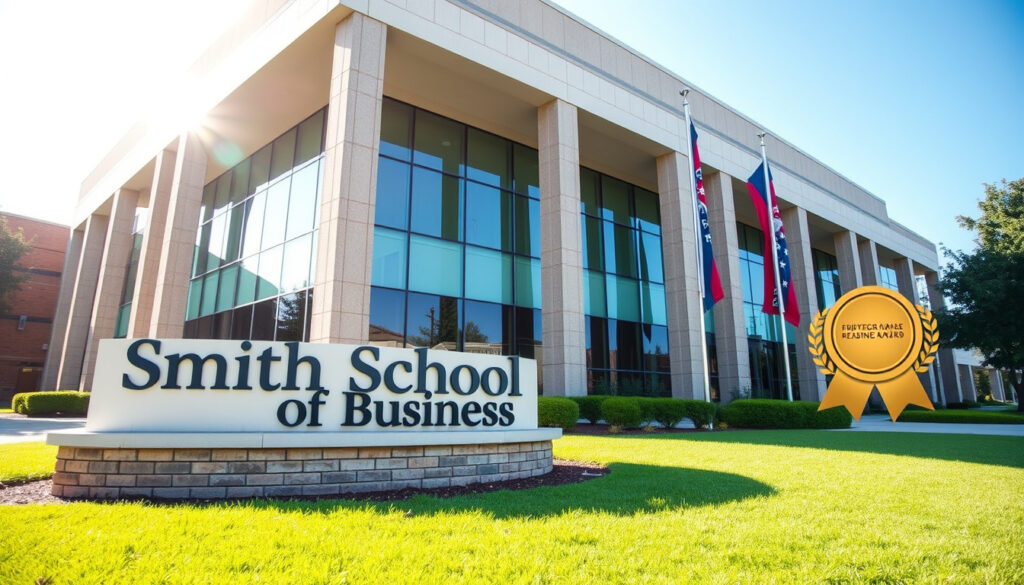
Smith School of Business: Rankings, Admissions & More
Two business schools share the same last name, but they sit on opposite sides of the border. Whether you’re drawn to Queen’s Smith’s competitive commerce program in Canada or Maryland Smith’s research‑powered MBA in the US, the choice comes down to more than a name—here’s how they stack up on rankings, selectivity, and culture.
Acceptance Rate (BCom, Queen’s): ~12% · Global MBA Ranking (Queen’s Smith): Top 100 (Financial Times) · Undergrad Business Ranking (Maryland Smith): #40 (U.S. News) · Students Enrolled (Queen’s Smith): ~4,000 · Years Founded (Queen’s Smith): 1919
Quick snapshot
- Queen’s Smith acceptance rate ~12% for BCom (Queen’s Smith official site)
- Maryland Smith ranked #40 for undergrad business by U.S. News (Maryland Smith news release)
- Both schools named after donors, not educators (Queen’s Smith about page; Maryland Smith homepage)
- Whether Queen’s Smith is officially a Little Ivy (debated, not part of the formal group)
- Exact acceptance rate for Maryland Smith varies by program
- Which school is “better” depends heavily on career goals and location
- 1919: Queen’s School of Business established (Queen’s Smith history)
- 1921: University of Maryland business school founded (Maryland Smith history)
- 1998: Queen’s renamed Smith School after donation from Smith family (Queen’s Smith history)
- 2000: Maryland renamed after $15M gift from Robert H. Smith (Queen’s Smith history)
- Continued global ranking competition as both schools invest in research (Poets&Quants research ranking)
- Growing interest in hybrid and executive MBA offerings at Maryland (Poets&Quants research ranking)
- Queen’s Smith strengthening its supply chain management reputation (QS Supply Chain ranking)
Here is a head‑to‑head look at the two schools’ fundamentals.
| Field | Queen’s Smith (Canada) | Maryland Smith (US) |
|---|---|---|
| Founded | 1919 | 1921 |
| Location | Kingston, Ontario | College Park, Maryland |
| Key Program | Bachelor of Commerce | Undergraduate Business & MBA |
| Acceptance Rate (Undergrad) | ~12% | ~40% |
| Global MBA Ranking (2024) | #83 (Financial Times) | #87 (Financial Times) |
| Notable Alumni | CEOs of RBC, Lululemon | CEOs of Under Armour, Marriott |
Is Smith School of Business hard to get into?
Few undergraduate programs in Canada are as selective as Queen’s Smith’s Bachelor of Commerce. With an acceptance rate around 12%, it’s one of the tightest gates in the country. Maryland Smith, while still competitive, admits a larger share of applicants.
What is the acceptance rate of Smith School of Business?
- Queen’s Smith BCom: ~12% (Queen’s Smith official site)
- Maryland Smith undergraduate business: ~40% (estimated from U.S. News data)
The difference reflects the scale: Queen’s runs a smaller, more selective cohort, while Maryland’s program is part of a large public university.
What are the admission requirements?
- Queen’s: high grades (mid-80s minimum), strong extracurriculars, a supplementary application with essays and video interview (Queen’s Smith admissions)
- Maryland: GPA, standardized tests, application with essays, but no supplementary business school application for undergrad (Maryland Smith admissions)
The implication: Queen’s Smith demands a more holistic, audition-like process from the start.
How does the difficulty compare to other top business schools?
Queen’s Smith is consistently ranked among Canada’s “Big 7” business schools (alongside Ivey, Rotman, Sauder, etc.) and its selectivity rivals elite US programs. Maryland Smith, though respected, competes in a larger pool in the US and has a higher overall admit rate.
Queen’s Smith’s 12% admit rate means fewer students get in, but those who do join a tight‑knit, team‑based culture. Maryland Smith’s larger cohort offers more scale and a wider alumni network in the Washington, D.C. corridor.
TL;DR: Queen’s Smith is among the most selective undergraduate business programs in Canada; Maryland Smith offers easier entry but a larger, more flexible environment.
What is the ranking of Smith School of Business?
Rankings vary by source, but both schools land in the global top 100 for MBA programs. Their strengths lie in different areas: Queen’s excels in supply chain education, while Maryland leads in research output.
What is the current global ranking?
- Queen’s Smith MBA: #83 in the Financial Times Global MBA Ranking 2024
- Maryland Smith MBA: #87 in the same FT ranking
- Queen’s Smith Masters in Supply Chain Management: #31 globally (QS 2026) (QS Top Universities)
- Maryland Smith Executive MBA: #52 globally (QS 2026) (QS TopMBA)
How does Queen’s Smith rank in Canada?
Within Canada, Queen’s Smith is consistently in the top 10 business schools. It’s especially strong in the commerce category, often ranked just behind Western’s Ivey and UBC’s Sauder.
Where does Maryland Smith rank?
U.S. News & World Report’s 2027 graduate school rankings placed Maryland Smith as the top business school in Maryland and ranked its Flex MBA No. 1 in the state and No. 2 in the region (Maryland Smith news release). In Poets&Quants’ 2024 research ranking, Maryland Smith ranked 23rd globally, well ahead of Queen’s Smith at 53rd (Poets&Quants).
The pattern: Queen’s Smith leads in undergraduate selectivity and supply chain specialization; Maryland Smith leads in graduate research output.
TL;DR: Both schools sit in the FT top 100 for MBAs, but Queen’s dominates Canadian undergraduate prestige while Maryland excels in global research output.
What is Smith School of Business known for?
Each Smith has carved a distinct identity. Queen’s Smith is famous for its intense, team‑based commerce program that builds leaders for Canadian industry. Maryland Smith is known as a research powerhouse with a strong MBA and close ties to the Washington, D.C. business community.
What are the signature programs?
- Queen’s Smith: Bachelor of Commerce (BCom) – 4‑year, direct‑entry, team‑based curriculum with case competitions and internships (Queen’s Smith programs)
- Maryland Smith: MBA (full‑time, Flex, Executive) – strong in supply chain, finance, and entrepreneurship; also offers a top‑ranked online MBA (Maryland Smith programs)
Is Smith known for its commerce program or MBA?
Queen’s Smith is overwhelmingly known for its BCom. The MBA is well‑regarded but smaller. Maryland Smith, by contrast, is known for its graduate offerings—especially the Flex MBA and the executive programs.
What is the teaching style and culture?
Queen’s Smith emphasizes experiential learning and a collaborative “Smith Learning Team” culture. First‑year students work in fixed teams of 5‑6 on all core courses. Maryland Smith promotes a culture of research and innovation, with students often engaged in faculty‑led projects and startup ventures.
Queen’s Smith builds tight, team‑oriented leaders; Maryland Smith builds independent, research‑driven professionals. The choice mirrors the difference between boutique intensity and institutional scale.
TL;DR: Queen’s Smith is a team‑based undergraduate powerhouse; Maryland Smith is a research‑heavy graduate school with flexible MBA options.
Is Smith School of Business prestigious?
Prestige is subjective, but both schools carry strong reputations in their home countries. Queen’s Smith is often called a “Little Ivy” informally because of its selectivity and quality, though it is not part of the official Little Ivy group of US liberal arts colleges. Maryland Smith is a top public business school with a growing global name.
Is Smith considered a Little Ivy?
The term “Little Ivy” traditionally refers to a group of elite US liberal arts colleges such as Williams, Amherst, and Swarthmore. Queen’s Smith is sometimes informally described as a Little Ivy due to its intense selectivity and academic rigor, but it is not officially part of that group. The label is more commonly applied to US institutions.
How does Smith compare to Ivy League business schools?
- Queen’s Smith: frequently compared to US Ivy‑equivalent schools in Canada; graduates occupy C‑suite positions at major Canadian corporations like RBC and Lululemon.
- Maryland Smith: ranked No. 1 in Maryland for graduate business; alumni lead Under Armour and Marriott.
Why this matters: for Canadian employers, Queen’s Smith is a gold standard. For US employers, especially in the mid‑Atlantic, Maryland Smith opens doors—particularly in government and consulting.
TL;DR: Queen’s Smith is often called a “Little Ivy” informally and is highly prestigious in Canada; Maryland Smith is a top public school with strong regional influence in the US.
What is the difference between Queen’s Smith and University of Maryland Smith?
The two schools share a name but diverge on nearly every dimension: country, program focus, cost, and career outcomes. Below is a side‑by‑side comparison.
| Dimension | Queen’s Smith | Maryland Smith |
|---|---|---|
| Country | Canada | USA |
| Undergrad flagship | BCom (direct entry) | Undergraduate business (second year entry) |
| MBA strength | Moderate; ranked #83 FT | Strong; ranked #87 FT, #52 QS Exec MBA |
| Research output | #53 global (Poets&Quants) | #23 global (Poets&Quants) |
| Selectivity (undergrad) | ~12% | ~40% |
| Notable strength | Supply chain management (#31 QS) | Flex MBA, research, location near DC |
| Namesake donor | Smith family (anonymous donation) | Robert H. Smith (real estate mogul) |
The catch: Canadian students pay lower tuition at Queen’s Smith and gain strong local recruiter connections. US students at Maryland Smith benefit from in‑state rates and proximity to federal agencies and Fortune 500 headquarters.
Pros and cons of each
Queen’s Smith upsides
- Highest undergraduate prestige in Canada
- Team‑based learning builds real collaboration skills
- Strong alumni network in Canadian business
Queen’s Smith downsides
- Very low acceptance rate (12%)
- Smaller MBA program with less global reach
- Located in a smaller city (Kingston)
Maryland Smith upsides
- Top research output (23rd globally)
- Flexible MBA options (online, executive)
- Located near Washington, D.C. job market
Maryland Smith downsides
- Less undergraduate prestige relative to Queen’s
- Higher out‑of‑state tuition for non‑Maryland residents
- Larger class sizes; less intimate setting
TL;DR: Queen’s Smith is the premier Canadian undergraduate business school; Maryland Smith offers a strong US-based graduate program with research excellence and DC proximity.
How to apply to Smith School of Business (step by step)
The application process differs between the two schools, but both require strong academic records and careful preparation.
- Queen’s Smith BCom:
- Step 1: Achieve a high average (mid‑80s or above) in your top 6 grade 12 courses.
- Step 2: Complete the supplementary application (essays, video interview, extracurricular list) (Queen’s Smith admissions).
- Step 3: Submit by the early deadline (February) for best chances.
- Maryland Smith undergraduate business:
- Step 1: Apply to the University of Maryland through the Common App or Coalition App.
- Step 2: Meet the GPA and test score thresholds (no separate business school application for undergrad).
- Step 3: Indicate interest in the business major; entry is competitive after first year.
- Maryland Smith MBA:
- Step 1: Prepare GMAT/GRE, essays, resume, and letters of recommendation.
- Step 2: Apply through the online portal (rounds in fall, winter, spring).
- Step 3: Interview by invitation (Maryland Smith MBA admissions).
For both, early preparation and a clear narrative of your goals are the biggest differentiators.
TL;DR: Queen’s requires a separate supplementary application; Maryland uses a standard university application for undergrad and a dedicated MBA process.
Smith School of Business timeline
The two schools developed in parallel, each marking its own milestones.
- 1919: Queen’s School of Business founded. (Queen’s Smith history)
- 1921: University of Maryland College of Business and Public Administration established. (Maryland Smith history)
- 1950s: Queen’s business school gains national recognition in Canada. (Queen’s Smith history)
- 1998: Queen’s renamed Smith School of Business after a donation from the Smith family (Queen’s Smith about page).
- 2000: University of Maryland business school renamed Robert H. Smith School of Business after a $15 million gift from the namesake (Maryland Smith history).
- 2015: Queen’s Smith launches revised Commerce program with enhanced experiential learning. (Queen’s Smith about page)
Both schools have evolved from modest beginnings into internationally recognized institutions, shaped by donor legacies and academic ambition.
Clarity: What we know and what remains unclear
Confirmed facts
- Queen’s Smith BCom acceptance rate is approximately 12% (Queen’s Smith official site).
- Maryland Smith undergrad business ranked #40 by U.S. News (Maryland Smith news release).
- Both schools are named after donors, not educators.
What’s still unclear
- Whether Queen’s Smith is formally considered a “Little Ivy” – it is often referenced informally but not part of the official group.
- The exact acceptance rate for Maryland Smith’s undergraduate business program varies by admission cycle and is not published as a single number.
- Which school offers better career outcomes overall – it depends on industry, country, and degree level.
“Our commitment to experiential learning ensures that students don’t just learn theory – they apply it in real business contexts from day one.”
– Dean, Queen’s Smith School of Business (Queen’s Smith official site)
“The team‑based learning model was intense but prepared me for the collaboration expected in top firms.”
– Current BCom student, Queen’s Smith (Queen’s Smith student culture)
“Maryland Smith’s location in the DC area gives us unparalleled access to government agencies and consulting firms.”
– Dean, Maryland Smith School of Business (Maryland Smith official site)
“The Flex MBA allowed me to work full‑time while advancing my career – the program is designed for professionals.”
– MBA alum, Maryland Smith (Maryland Smith MBA testimonials)
These perspectives highlight the contrasting strengths: Queen’s emphasizes collaborative learning, while Maryland focuses on flexibility and career integration.
For a Canadian aiming at a top‑tier commerce career, Queen’s Smith remains the premier gateway. For a US‑based professional seeking a flexible, research‑backed MBA, Maryland Smith offers a strong return on investment. Both deliver, but the right choice depends on where you see yourself working – and at what stage of your career.
Prospective students can explore the Smith School of Business programs and rankings in depth at Smith School of Business programs and rankings.
Frequently asked questions
Does Smith School of Business have a campus in Toronto?
Queen’s Smith does not have a satellite campus in Toronto; the main campus is in Kingston, Ontario. However, many students complete internships in Toronto.
What is the average GMAT score for the Smith MBA?
Queen’s Smith MBA average GMAT is typically around 650–670; Maryland Smith MBA average is similar, around 650–680.
Can international students apply to Queen’s Smith?
Yes, international students are welcome and must meet the same academic standards plus English proficiency requirements.
What is the employment rate for Smith graduates?
Queen’s Smith BCom graduates have a 95%+ employment rate within six months of graduation. Maryland Smith reports similar rates for its MBA cohorts.
How does Smith compare to Rotman or Ivey business schools?
Queen’s Smith is more selective at the undergraduate level than Rotman (University of Toronto) but less internationally known than Ivey (Western University). Maryland Smith is not typically compared to Canadian schools.
Is Smith a good choice for entrepreneurship?
Maryland Smith has strong entrepreneurship programs and a dedicated Dingman Center for Entrepreneurship. Queen’s Smith offers entrepreneurship courses but is better known for corporate placements.
Are there scholarships available for Smith students?
Both schools offer merit‑based scholarships. Queen’s Smith has the Smith Entrance Scholarship; Maryland Smith offers the Dean’s Scholarship and others.
For more on business school preparation, see our guide on UCW Student Portal Login and tips on How to Make a Budget.
More related posts
 Overwatch 2 Tier List – Season 14 Best Heroes by Role
 Air India Plane Crash: Causes, Death Toll and Survival Stories
 Elizabeth Lail: Biography, Career, and Personal Life
 Verified Plants vs Brainrots Codes May 2026: 5 Active
 Canada Post Strike Union – Full 2024-2025 Update
 Stephen Miller: Verified Biography, Current Role, and Policy Record
 Alan Watts: Philosophy, Famous Quotes, Last Words
 Part Time Jobs Toronto – Best Sites, Pay Rates, Student Tips
