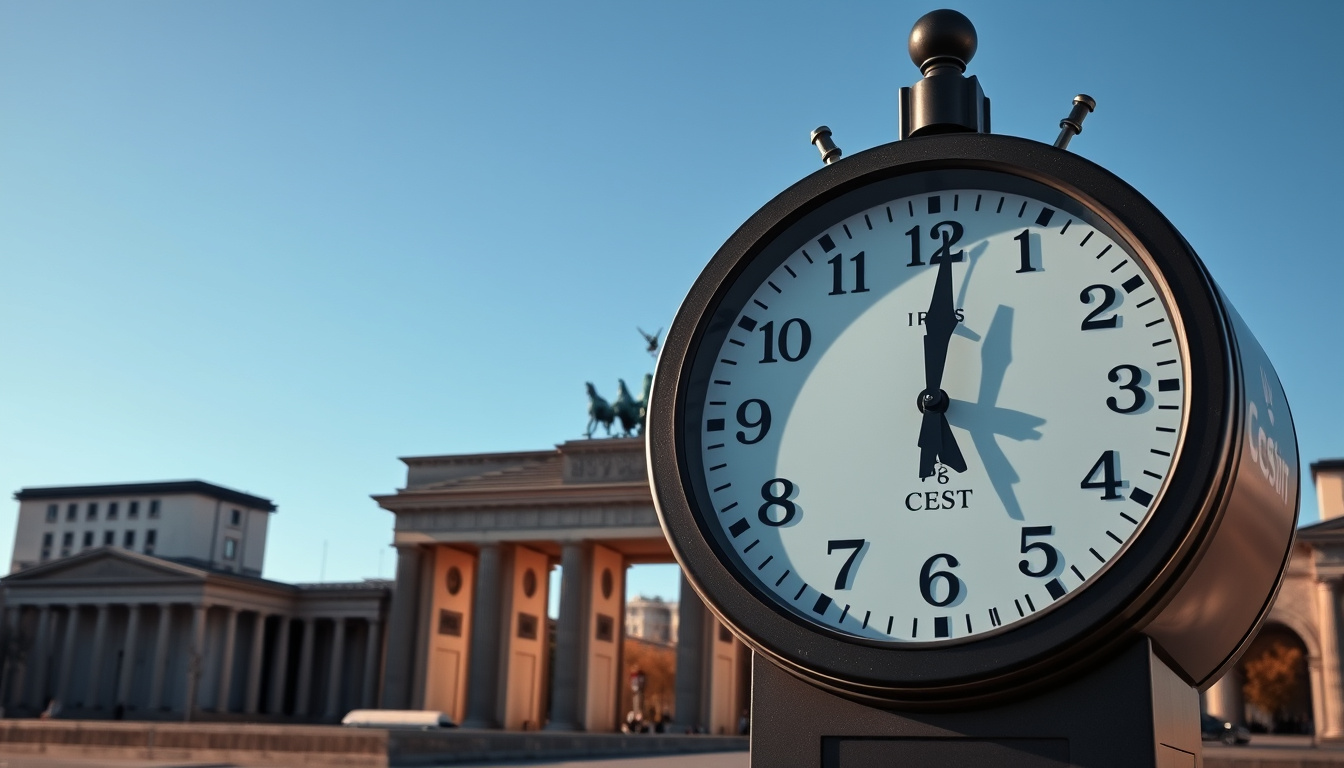

Germany operates on a single time zone for the entire country—a convenience that makes it easy to pin down, but the daylight saving schedule means the UTC offset shifts twice a year. That seasonal flip is where people get caught. Below is a full breakdown of Germany’s time, how it compares to the US and Ireland, and what you need to know before you dial.
Current Time Zone: Central European Summer Time (CEST) · UTC Offset: UTC+2 · DST Active: Yes (March to October) · Major Cities: Berlin, Munich, Frankfurt
Quick snapshot
- Germany uses a single time zone nationwide (time.is)
- Currently observing CEST at UTC+2 (time.is)
- Berlin is the largest city in the CEST zone with ~3.4 million residents (Savvy Time)
- Exact sunrise/sunset times vary day-to-day across German cities
- Real-time clock data requires external verification at query moment
- DST started March 29, 2026 at 02:00 → 03:00 (Zeitverschiebung)
- DST ends October 25, 2026 at 03:00 → 02:00 (time.is)
- Germany returns to CET (UTC+1) on October 25, 2026 (time.is)
- Schedule calls between 15:00–18:00 Berlin time for US CST overlap (Savvy Time)
Germany’s unified time approach spans 577 cities, with only the UTC offset changing twice yearly.
| Attribute | Current Value | Standard Value |
|---|---|---|
| Time Zone | CEST (UTC+2) | CET (UTC+1) |
| IANA Identifier | Europe/Berlin | Europe/Berlin |
| DST Start | Last Sunday in March | — |
| DST End | Last Sunday in October | — |
| Total Locations | 577 cities | 577 cities |
What Time Is It in Germany Right Now?
Germany does not operate on multiple time zones. Every city from Berlin to Munich to Frankfurt shares the same clock. As of May 2026, the country is in Central European Summer Time, which means the offset sits at UTC+2 (time.is). If you check a live clock for any major German city, you’ll see the same reading.
The IANA time zone identifier for this region is Europe/Berlin, which is the standard reference used by computer systems worldwide (time.is). In German, the summer offset is called Mitteleuropäische Sommerzeit (MESZ), while the standard winter time is Mitteleuropäische Zeit (MEZ) (WorldTimeServer).
At 10:00 PM CEST in Berlin, it is 3:00 PM CDT.
Current time with seconds
Live time displays update every second and pull from atomic clock data. You can find the current Berlin time with precise second-by-second accuracy at time monitoring services that sync to global time standards.
AM/PM format
Germany uses the 24-hour clock exclusively—common across most of Europe. So rather than 3:00 PM, you’ll see 15:00. This applies to train schedules, business hours, and public transportation across all German cities.
The implication: US-based schedulers must convert to 24-hour format when coordinating with German partners.
What Time Zone Is Germany In?
Germany falls within the Central European Time zone. During standard time (winter months), the offset is UTC+1. When daylight saving is active (summer months), the offset shifts to UTC+2 (WorldTimeServer). This two-tier system applies uniformly to the entire country.
The CET time zone covers a broad geographic band, running through northern Europe, central Europe including portions of the UK, and even parts of northern Africa (WorldTimeServer). Other major cities sharing this zone include Madrid, Rome, Paris, and Budapest (Savvy Time).
Central European Time (CET/CEST)
CET and CEST are the same zone with different seasonal offsets. CET is the base zone (UTC+1), while CEST is the daylight saving variant (UTC+2) (Savvy Time). Central European Summer Time is observed during summer months in Central Europe, adding one hour to standard time.
UTC+1/+2 offset
The current UTC offset for Germany during daylight saving time is UTC/GMT +2:00 hours. In standard (winter) time, it is UTC/GMT +1:00 hour (24 Time Zones). This 1-hour shift occurs twice per year, always on the last Sunday of March and October.
Central European Summer Time (CEST) is a daylight saving/summer time zone, however during winter some places adjust time for one hour back and observe Central European Time (CET).
— Savvy Time
For businesses coordinating with German offices, the DST switch means your 9 AM call in New York lines up with 3 PM in Berlin during summer—but that window moves to 2 PM in winter. Missing the seasonal shift causes missed meetings.
The pattern: European DST transitions create brief misalignments with North American schedules each spring and fall.
Is Germany One Hour Ahead of Ireland?
Yes, Germany is typically one hour ahead of Ireland. Both countries observe the same DST schedule—clocks change on the last Sunday of March and the last Sunday of October—so the one-hour gap remains constant year-round (Savvy Time).
When it is noon in Dublin, it is 13:00 in Berlin. This holds whether both countries are on standard time or both on summer time, because they shift together.
Ireland time zones
Ireland uses Western European Time (WET) and Western European Summer Time (WEST), which aligns precisely with the UTC offsets used in Germany. The shared DST schedule means the hour-long differential between Dublin and Berlin stays fixed at all times of year.
Hourly difference details
The consistent one-hour difference makes scheduling straightforward. A call scheduled for 10:00 in Dublin will always reach Berlin at 11:00—no conversion calculation required, and no seasonal adjustment headaches.
What this means: Travelers and business schedulers can ignore Ireland-Germany time differences entirely.
Time Difference Between Germany and the United States
The time gap between Germany and the US varies depending on which American region you’re comparing. Berlin is normally 6 hours ahead of New York City. However, because daylight saving time in Europe and North America does not always start and end on the same dates, Berlin can be only 5 hours ahead for a brief window each spring (time.is).
US-to-Germany comparisons shift by roughly one hour as you move west across American time zones.
| German City | vs. New York (EDT) | vs. Chicago (CDT) | vs. Los Angeles (PDT) |
|---|---|---|---|
| Berlin | 6 hours ahead | 7 hours ahead | 9 hours ahead |
| Munich | 6 hours ahead | 7 hours ahead | 9 hours ahead |
| Frankfurt | 6 hours ahead | 7 hours ahead | 9 hours ahead |
US East Coast
During Eastern Daylight Time, New York is 6 hours behind Berlin. At 10:00 AM in New York, it is 4:00 PM in Berlin. This gap applies to all major East Coast cities including Boston, Washington D.C., and Miami.
US West Coast
When Berlin is on CEST (UTC+2) and Los Angeles is on Pacific Daylight Time (UTC-7), the gap is 9 hours. The best window for a conference call between Berlin and Los Angeles is between 8:00 AM and 11:00 AM Los Angeles time, which translates to 17:00 to 20:00 in Berlin (Savvy Time).
Conversion tool notes
The most reliable method for converting times across these zones is to use an IANA-based converter that accounts for DST transitions automatically. Many calculators allow you to input a date and see the exact offset for that specific moment, rather than relying on a static difference.
During the brief window each spring when European DST has started but North American DST has not, Berlin can be 5 hours ahead of New York instead of the usual 6. The same reverse gap can occur in fall. Always verify the exact date range for your scheduling window.
Current Time in Major German Cities
Because Germany operates on a single time zone, the clock reads the same across all major cities. Berlin, Munich, Hamburg, Frankfurt, Cologne, Stuttgart, and every other German municipality show identical time throughout the day (time.is).
The three largest German cities demonstrate this uniform timekeeping approach.
| City | Population | Time Zone Role |
|---|---|---|
| Berlin | ~3.4 million | Capital; primary time reference |
| Munich | ~1.5 million | Bavaria hub; same CEST |
| Frankfurt | ~750,000 | Financial center; airport hub |
Berlin time
Berlin is the largest city in the CEST timezone with a population of approximately 3.426 million people (Savvy Time). The city serves as the de facto time reference for the entire country—if you know the time in Berlin, you know the time anywhere in Germany.
Munich time
Munich, the capital of Bavaria, shares the exact same time as Berlin. No adjustment is needed for calls between Munich and Berlin, regardless of whether you’re scheduling a business meeting or tracking arrival times for flights.
Frankfurt time
Frankfurt, home to Germany’s main financial hub and the country’s busiest airport, also runs on the same clock. Train schedules from Frankfurt Hauptbahnhof, flight departure boards, and stock market opening bells all operate on the same Central European Summer Time used across the country.
The implication: German logistics operators can coordinate across the country without regional time adjustments.
Upsides
- Single time zone means no regional confusion within Germany
- DST schedule aligns with most of Europe for coordinated business
- UTC+2 during summer provides long summer evenings
- Berlin is the largest city in the CEST zone, making it a reliable reference point
Downsides
- One-hour shift twice yearly requires schedule adjustments
- Brief misalignment with US East Coast during DST transitions
- Limited daylight in winter months at northern latitudes
- No state-level variation for cities like Munich or Frankfurt
24timezones.com, worldtimebuddy.com, 24timezones.com, worldtimebuddy.com
Germany runs a single time zone nationwide from Berlin and Munich to Frankfurt, where current CET/CEST details outline the latest DST adjustments and clock shifts.
Frequently asked questions
Does Germany observe daylight saving time?
Yes, Germany observes daylight saving time annually. Clocks move forward one hour on the last Sunday in March (from 02:00 to 03:00) and fall back one hour on the last Sunday in October (from 03:00 to 02:00) (Zeitverschiebung).
What is GMT offset for Germany?
During standard time, Germany is GMT/UTC+1. During daylight saving time, it is GMT/UTC+2 (24 Time Zones).
Are all German cities in the same time zone?
Yes, every German city from Berlin to Munich to Hamburg operates on the same time. There are no regional variations within Germany (time.is).
How does Germany time compare to UK?
Germany is typically one hour ahead of the UK. When both countries are on summer time, the gap stays at one hour. During winter, when the UK is on Greenwich Mean Time (GMT) and Germany is on Central European Time (CET, UTC+1), the difference remains one hour (Savvy Time).
What time is sunrise in Berlin?
Sunrise times in Berlin vary by season. During May 2026, sunrise occurs around 5:15–5:30 AM local time. In December, sunrise may not occur until after 8:00 AM. Exact times shift daily and are available through weather and time services.
Is there time difference within Germany?
No, there is no time difference between German cities. The entire country follows one time zone, so Munich, Frankfurt, Hamburg, Cologne, and Dresden all show the same time at any given moment.
When does DST change in Germany?
DST in Germany starts on the last Sunday in March and ends on the last Sunday in October. For 2026, clocks spring forward on March 29 and fall back on October 25 (time.is).
For anyone coordinating with German colleagues, the key takeaway is straightforward: check whether you’re in daylight saving season, apply the UTC+2 offset during summer or UTC+1 during winter, and account for the brief US misalignment windows in spring and fall. A reliable IANA-based converter handles the rest.
Related stories





Jessica Morin covers provincial policy and regional economic trends.