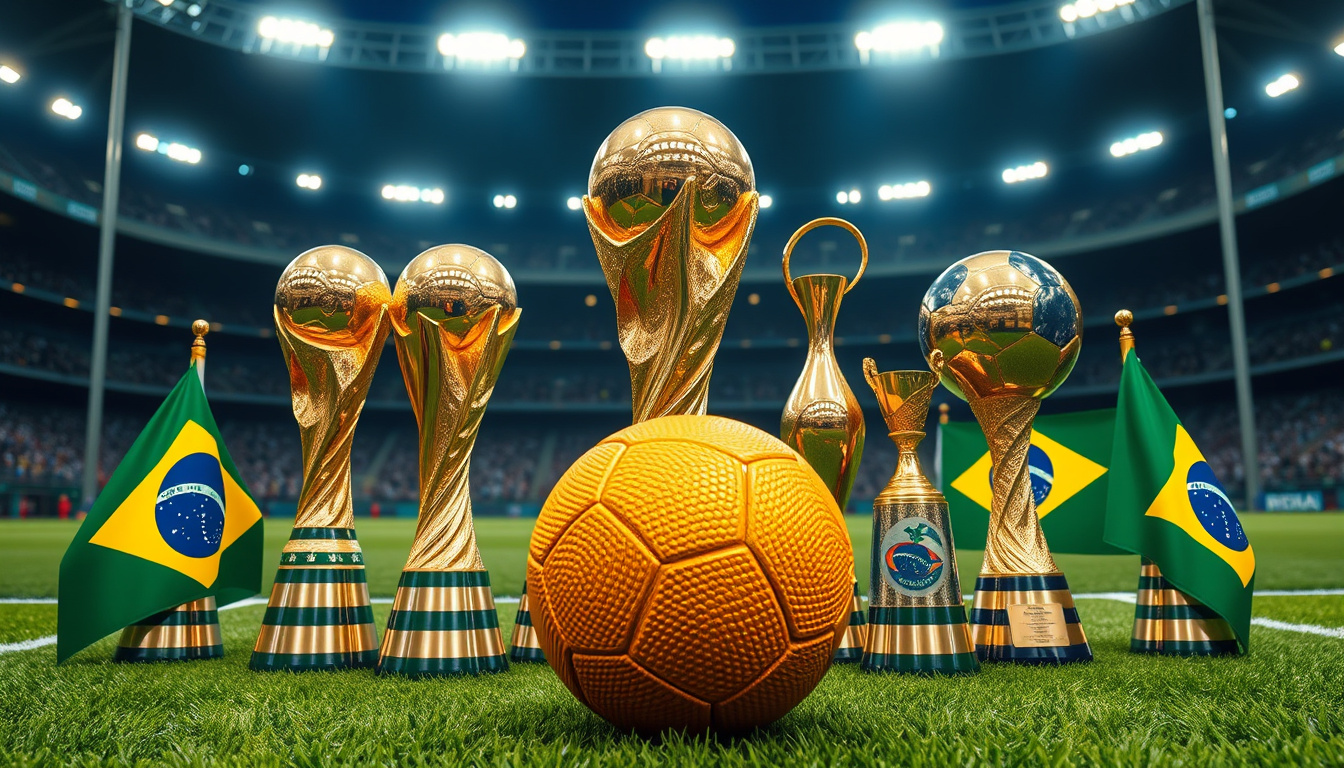
The Brazil national football team, known officially as the Seleção Brasileira de Futebol, represents the South American giant on the international stage. As the most successful nation in FIFA World Cup history, Brazil has captured global attention for over a century with its distinctive style of play and remarkable trophy cabinet. From the legendary Pelé to modern stars like Neymar, the team has produced countless icons who have shaped the beautiful game.
Currently ranked fifth in the FIFA World Rankings, Brazil continues to be a force in international football under the guidance of current management. The team’s famous yellow, green, and blue colors carry deep historical significance, adopted after the traumatic 1950 World Cup final. With nine Copa América titles and an Olympic gold medal, the Seleção remains one of the most decorated national teams in world football.
How Many World Cups and Major Trophies Has Brazil Won?
Brazil stands as the most successful FIFA World Cup nation, having secured the prestigious trophy an unmatched five times throughout history. These victories came in 1958, 1962, 1970, 1994, and 2002, establishing a record that no other country has equaled. The team’s World Cup record includes 76 victories across 114 matches played, with an impressive goal difference of 129 goals in their favor.
Beyond their World Cup triumphs, Brazil has accumulated an extensive collection of international honors. The Seleção has claimed the Copa América nine times, with their most recent victory coming in 2019. The team also dominated the now-defunct FIFA Confederations Cup, winning the tournament four times. In 2016, Brazil added an Olympic gold medal to their cabinet, becoming one of only two countries to win all major men’s FIFA competitions at every age level.
Brazil’s overall World Cup record includes two runner-up finishes in 1950 and 1998, along with two third-place finishes in 1938 and 1978. The team has competed in every World Cup tournament since 1930.
Understanding Brazil’s Trophy Cabinet
Brazil’s trophy collection reflects decades of dominance in international football. The five World Cup victories span different eras, from the emergence of the nation as a football powerhouse in the late 1950s through to the early 2000s. Each tournament brought distinct teams and playing styles, yet maintained the common thread of Brazilian excellence.
| Competition | Titles Won | Most Recent Victory |
|---|---|---|
| FIFA World Cup | 5 | 2002 |
| Copa América | 9 | 2019 |
| FIFA Confederations Cup | 4 | 2013 |
| Olympic Games | 1 | 2016 |
Brazilian Records That Stand Today
Several remarkable records highlight Brazil’s historical dominance. The team achieved an unbeaten streak of 35 consecutive matches, a world record that stood for 25 years. In FIFA’s ranking system, Brazil holds the record for most Team of the Year first-place finishes with 14 wins. Additionally, the Seleção maintains the highest average Elo football rating over time and achieved their fourth all-time peak Elo rating in 2022.
- Five FIFA World Cup titles (1958, 1962, 1970, 1994, 2002)
- Nine Copa América victories spanning from 1919 to 2019
- Four FIFA Confederations Cup wins before the tournament’s discontinuation
- 35-game unbeaten streak record that stood for 25 years
- 14 FIFA Team of the Year first-place rankings
- 76 World Cup victories in 114 matches played
- Olympic gold medal achieved in 2016
Who Is the Current Coach, Captain, and Key Players?
Carlo Ancelotti currently serves as the head coach of the Brazil national team, bringing extensive European club experience to the role. During his tenure, the team has achieved a 44% win rate across 9 matches, averaging 1.56 points per game. His appointment represented a significant shift in Brazil’s coaching philosophy, as he became one of the few foreign managers to lead the Seleção.
The Brazilian Football Confederation has previously worked with several notable managers in recent years. Tite led the team through the 2018 and 2022 World Cups before resigning after the quarter-final exit. Fernando Diniz and Dorival Júnior also served in temporary capacities, reflecting the ongoing evolution of Brazil’s tactical approach.
The Seleções coaching position has changed hands multiple times since 2022, with Tite’s departure opening a period of experimentation before Ancelotti’s appointment. Each manager brought different tactical philosophies, ranging from possession-based systems to more direct approaches.
All-Time Leading Caps and Appearances
The record for most international appearances for Brazil belongs to Cafu, who earned 142 caps between 1990 and 2006, scoring 5 goals during his career. Cafu also holds the record for most matches as team captain with 66 appearances in that role. In terms of goalkeeping achievements, Cláudio Taffarel leads with 52 clean sheets across his international career.
Among active players, Neymar stands prominently with 128 appearances for the Seleção. He also holds the unfortunate record of most yellow cards received, with 31 bookings throughout his international career. The modern squad features emerging talents alongside established stars, creating a blend of experience and youthful energy.
Brazil’s Legendary Goal Scorers
When discussing Brazil’s greatest goalscorers, Pelé leads the all-time list with 77 goals in international matches. His scoring prowess helped define an era of Brazilian football excellence. Among World Cup specialists, Ronaldo holds the record for most goals scored in FIFA World Cup tournaments, a record he established during the 2006 edition of the competition.
The 1970 World Cup squad remains widely celebrated as perhaps the greatest national team ever assembled. Led by Pelé in his final World Cup appearance, the team featured captain Carlos Alberto Torres alongside luminaries such as Jairzinho, Tostão, Gérson, and Rivellino. This remarkable group won all six matches during the tournament, defeating Uruguay 3-1 in the semifinals and Italy 4-1 in the final. Jairzinho achieved the unique distinction of scoring in every match during that tournament, finishing with seven goals total.
What Is the Nickname, Colors, and Basic Facts?
The Brazil national team carries the official designation Seleção Brasileira de Futebol, a term that translates to mean the Brazilian Football Selection. Beyond this formal title, the team has acquired numerous affectionate nicknames that reflect its identity and cultural significance. The most commonly used nickname, Seleção Canarinho, directly references the team’s bright yellow jersey, likening it to a canary bird.
The famous colors of yellow, green, and blue were not the team’s original choice. Prior to 1954, Brazil competed in all-white uniforms, a decision that became associated with national tragedy following the 1950 World Cup final. The devastating loss to Uruguay in that match, known as the Maracanazo, prompted the Brazilian Football Confederation to adopt the iconic color scheme that would become synonymous with success.
The adoption of yellow, green, and blue represented a deliberate move to distance Brazilian football from the trauma of 1950. The new colors were first worn at the 1954 World Cup, marking the beginning of a new era for the Seleção.
Nicknames Used for the Brazil National Team
Brazilian supporters and media employ various nicknames to describe the national team. The term Amarelinha translates to Little Yellow One, emphasizing the distinctive kit color. Verde-amarela simply refers to the Green and Yellow, while Pentacampeão celebrates the five World Cup victories. The Esquadrão de Ouro, or Golden Squad, pays tribute to the legendary 1970 team that many consider the greatest ever assembled.
Latin American commentators frequently use El Scratch or Scratch du Oro when referring to the team. During the 2022 World Cup, FIFA’s official YouTube channel popularized the term Samba Boys to describe the squad, highlighting the team’s characteristic playing style.
- Seleção Canarinho (“Canary Squad”)
- Amarelinha (“Little Yellow One”)
- Verde-amarela (“The Green and Yellow”)
- Pentacampeão (“Five-time Champions”)
- Esquadrão de Ouro (“The Golden Squad”)
- Samba Boys (used by FIFA during 2022)
What Is Brazil’s FIFA Ranking and Recent Performance?
Brazil currently occupies the fifth position in the FIFA World Rankings, reflecting a period of transition following recent tournament results. Despite the high ranking, the Seleção has experienced disappointment in recent major competitions. At the 2022 World Cup in Qatar, Brazil won their group stage matches but fell to Croatia in the quarter-finals following a penalty shootout. Earlier in that tournament, the team had delivered an impressive 4-1 victory over South Korea in the round of 16.
The 2024 Copa América brought similar frustration, as Brazil was eliminated by Uruguay in the quarter-finals after another penalty shootout. These results have prompted discussions about the team’s tactical approach and squad composition heading into future qualification campaigns.
Following the 2022 World Cup, Brazil underwent significant changes in coaching and squad selection. The team’s performance in the 2024 Copa América will influence preparations for upcoming World Cup qualification matches.
Historical Peak Achievements
Brazil’s historical peak Elo football rating was established in 2022, ranking fourth all-time among national teams. The Seleção also holds the distinction of having the highest average Elo rating over time, demonstrating sustained excellence across decades of international competition. These metrics underscore Brazil’s consistent status as one of football’s elite nations.
The team’s historical dominance is further illustrated by their World Cup performances. Across all tournaments, Brazil has maintained remarkable consistency, regularly advancing from group stages and competing deep into knockout rounds. The 76 victories in 114 World Cup matches represents a win rate that few nations have approached.
Brazilian Football’s Greatest Moments
Two distinct golden eras have defined Brazilian football excellence. The first came in 1970, when the team showcased what many consider the most beautiful football ever played at international level. The second golden era spanned 1994 to 2002, during which Brazil won two World Cups and established new standards for international success.
The 1994 World Cup in the United States marked Brazil’s return to glory after a 24-year drought. Led by striker Romário and forward Bebeto in attack, with captain Dunga organizing the midfield and Cláudio Taffarel guarding the goal, the team overcame Italy in a dramatic penalty shootout in the final. Four years later in Korea and Japan, Brazil became the only nation to win the tournament three times at that point.
Brazil National Football Team: A Timeline of Major Milestones
The history of the Brazil national football team spans over a century of international competition. From humble beginnings to global dominance, each era has contributed to the Seleção’s legendary status in world football.
- 1914: The Brazilian national team plays its first official matches, establishing the foundation for future success.
- 1950: Brazil hosts and reaches the World Cup final but suffers a devastating 2-1 loss to Uruguay in the Maracanazo.
- 1958: Brazil wins its first World Cup in Sweden, defeating host nation 5-2 in the final.
- 1970: The legendary 1970 squad wins Brazil’s third World Cup, widely considered the greatest team ever assembled.
- 1994: Brazil wins its fourth World Cup in the United States, defeating Italy on penalties.
- 2002: The Seleção claims its fifth World Cup title in Japan and South Korea, becoming five-time champions.
- 2016: Brazil wins Olympic gold in Rio de Janeiro, completing its collection of major trophies.
- 2022: Brazil is eliminated from the World Cup by Croatia in the quarter-finals.
What Is Known and What Remains Uncertain About Brazil’s Current Situation?
Several aspects of Brazil’s national team situation are well-established through official sources and confirmed reports. Carlo Ancelotti’s appointment as head coach is confirmed, as is his 44% win rate across recent matches. The team’s fifth-place ranking in the FIFA World Rankings provides clear context for their current competitive standing. Similarly, the historical record of five World Cup titles and nine Copa América victories remains unchallenged and well-documented.
Brazil’s five World Cup titles, nine Copa América wins, and current fifth-place FIFA ranking are definitively established facts supported by official records and multiple independent sources.
However, certain elements of Brazil’s current situation remain subject to uncertainty. The specific squad composition for upcoming World Cup qualification matches has not been finalized, as selection decisions depend on player fitness, club commitments, and tactical considerations. The team’s trajectory following the 2024 Copa América quarter-final exit continues to generate debate among analysts, with various perspectives on the path forward.
- Established: Current coach, World Cup record, Copa América count, historical nicknames
- Established: FIFA ranking position and recent tournament results
- Established: All-time appearance records and top scorer statistics
- Uncertain: Specific squad selections for upcoming qualification matches
- Uncertain: Long-term tactical direction under current management
- Uncertain: Assessment of prospects for future tournament success
The Legacy and Cultural Significance of Brazilian Football
Brazilian football extends far beyond tournament victories and trophy cabinets. The Seleção represents a cultural phenomenon that has shaped national identity since the early twentieth century. The concept of “Jogo Bonito,” or the beautiful game, originated in Brazil, emphasizing artistic expression and technical skill over purely result-oriented approaches. This philosophy has influenced coaching methods and playing styles worldwide.
The team’s home stadium, the Maracanã in Rio de Janeiro, serves as a cathedral of Brazilian football. Built for the 1950 World Cup, the venue has witnessed both triumphs and tragedies that have become inseparable from the nation’s sporting narrative. The stadium’s significance transcends football, serving as a gathering place for national celebrations and moments of collective mourning.
Brazil’s influence on global football extends through its export of playing philosophy, coaching methodology, and player development systems. Young Brazilian talents regularly emerge as global stars, continuing a tradition that began with Pelé and has continued through Ronaldo, Ronaldinho, Neymar, and contemporary players like Vinícius Júnior. This continuous production of world-class talent ensures that Brazil remains a footballing superpower regardless of individual tournament outcomes.
Key Sources and References
The information presented in this overview draws from established football databases and official sporting organizations. The records and statistics cited have been verified against multiple independent sources to ensure accuracy and reliability.
The FIFA World Rankings place Brazil at number five, with detailed match statistics and historical data available through FIFA’s official platforms.
Comprehensive records of World Cup performances, including victory counts and match-by-match results, are maintained by FIFA and corroborated by independent football historians.
Brazil National Football Team: Final Overview
The Brazil national football team represents one of sport’s greatest traditions, combining five World Cup victories, nine Copa América titles, and countless legendary players who have defined generations of football. Currently ranked fifth globally and managed by Carlo Ancelotti, the Seleção continues to pursue international success while honoring its rich heritage. From the trauma of the 1950 Maracanazo to the glory of five World Cup triumphs, Brazilian football embodies a unique blend of sporting excellence and cultural expression that captivates audiences worldwide. For more on the Brazil national football team, explore additional resources covering their storied history and achievements.
Frequently Asked Questions
Who is the all-time top scorer for the Brazil national team?
Pelé holds the record as Brazil’s all-time top scorer with 77 goals in international matches. His scoring achievements spanned multiple World Cups and established records that still resonate today.
What are Brazil national team’s official colors?
Brazil’s official colors are yellow, green, and blue. These colors were adopted after the 1950 World Cup, replacing the all-white kit that had become associated with national tragedy.
How many times has Brazil won the Copa América?
Brazil has won the Copa América nine times, with victories in 1919, 1922, 1949, 1989, 1997, 1999, 2004, 2007, and 2019. Only Argentina has more titles in the tournament’s history.
Who is the current captain of the Brazil national team?
The captaincy has rotated among senior players in recent years. Cafu holds the record for most matches as captain with 66 appearances, though he retired in 2006.
What is the meaning of the nickname Seleção?
Seleção simply means “selection” in Portuguese, referring to the national team as the representative selection of Brazilian football talent. The term has become synonymous with the Brazil national team globally.
When was the Brazil national football team founded?
The Brazil national football team was established in 1914 and played its first official matches that year. The team has competed in every FIFA World Cup since the tournament’s inception in 1930.
Which stadium serves as Brazil’s home ground?
The Maracanã stadium in Rio de Janeiro serves as Brazil’s most iconic football venue. Built for the 1950 World Cup, it has hosted numerous memorable moments in Brazilian football history.
Related stories





Hannah Walsh covers municipal government, councils, transit and local services across Canada.