
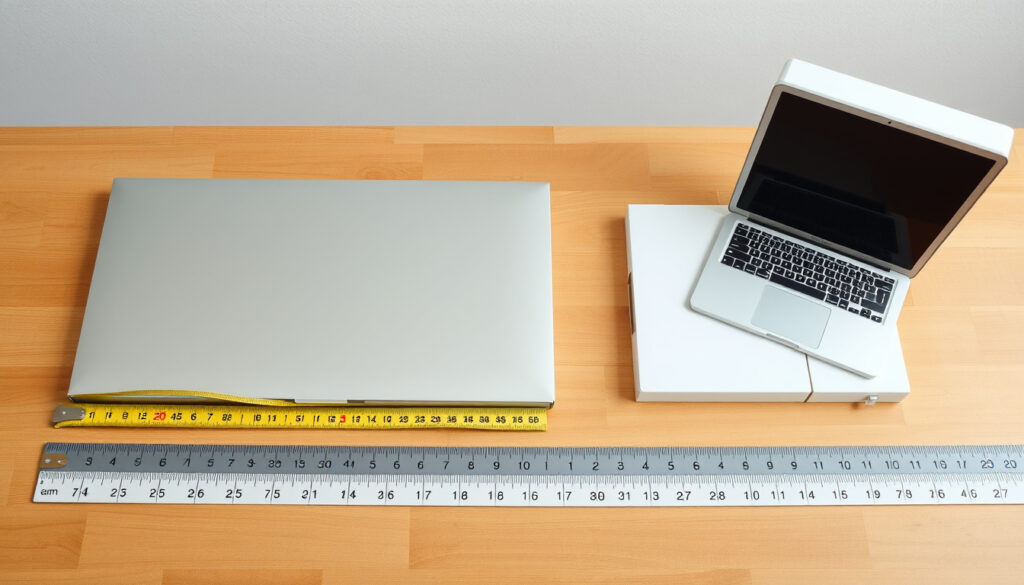
The question “how much is 16 inches in cm?” has one exact answer—40.64 centimeters—and once that number clicks, countless everyday decisions become easier: choosing laptop screens, buying picture frames, or estimating the length of hair extensions. This guide walks through the conversion formula, common frame sizes, and the real-world objects that measure out to 16 inches so you can stop guessing and start measuring with confidence.
16 inches equals: 40.64 cm · 1 inch equals: 2.54 cm · Conversion factor: Multiply inches by 2.54 · 16 inches as feet: 1 foot 4 inches
Quick snapshot
- 16 in = 40.64 cm exactly (Feet2Inches conversion calculator)
- 1 in = 2.54 cm by international standard (Feet2Inches conversion calculator)
- 16 in = 1.33 feet (Feet2Inches conversion calculator)
- Multiply inches × 2.54 = cm
- Divide cm ÷ 2.54 = inches
- 40.64 ÷ 2.54 = 16 ✓ (reverse check)
- 4 in longer than a 12-inch ruler (PD Measurement reference guide)
- Bowling pin ≈ 38.10 cm (The Measure of Things object database)
- Full-size bed = 190.50 cm (The Measure of Things object database)
- 16×12 in frame = 40.64 × 30.48 cm (A-Fotografy framing guide)
- 16×20 in frame = 40.6 × 50.8 cm (Profile Australia conversion chart)
- 16×16 sq frame = 40.6 × 40.6 cm (Profile Australia conversion chart)
What is 16 inches in cm?
Sixteen inches converts to 40.64 centimeters. This isn’t rounded—it’s the exact result of multiplying 16 by 2.54, the international standard for inch-to-centimeter conversion established by the yard and pound agreement between the United States and countries using the metric system.
Exact value
The calculation is straightforward: 16 × 2.54 = 40.64. This value holds because the inch is defined as exactly 2.54 centimeters by international agreement—a fixed ratio, not an approximation (Feet2Inches conversion calculator). You can verify the math in reverse: 40.64 ÷ 2.54 = 16.00, confirming the conversion is precise.
Sixteen inches also equals 1.33 feet. Since one foot contains 12 inches, 16 inches is 4 inches longer than a standard 12-inch ruler (PD Measurement reference guide). That extra one-third of a foot is handy context when visualizing the length.
The 2.54 cm per inch ratio is exact by definition, not measurement. This means any inch-to-centimeter conversion using 2.54 produces a mathematically precise result.
Decimal and fraction equivalents
Working with 40.64 cm, you might encounter it expressed in different formats depending on the context:
- Decimal: 40.64 cm (most common in conversion tools and scientific contexts)
- Millimeters: 406.4 mm (useful for precise engineering or manufacturing specifications)
- Feet and inches: 1 ft 4 in (helps visualize relative size in imperial units)
The measurement also shows up in milliliters when discussing volume, though that’s a separate conversion entirely. For length measurements, stick with 40.64 cm or 406.4 mm.
How to convert 16 inches in cm?
The conversion formula is simple: multiply the number of inches by 2.54 to get centimeters. For 16 inches specifically: 16 × 2.54 = 40.64 cm. This works every time because 2.54 is a fixed constant, not a variable approximation.
Step-by-step formula
Here’s the process broken down:
- Take your measurement in inches (16 in this case)
- Multiply by 2.54
- Read the result in centimeters (40.64 cm)
For the reverse conversion—from centimeters to inches—divide by 2.54 instead. So 40.64 cm ÷ 2.54 = 16 inches exactly. This symmetry confirms the calculation is correct.
To convert any inch value to centimeters, multiply by 2.54. To convert centimeters to inches, divide by 2.54.
Using online converters
If you prefer to skip the mental math, free online converters handle this instantly. Most conversion calculators on sites like RapidTables or UnitConverters.net accept either unit as input and display the result immediately. Enter “16 inches” and you’ll see “40.64 cm” in the output field.
For repeated conversions—such as when comparing multiple frame dimensions or product sizes—consider bookmarking a reliable converter. Some converters also batch-process multiple values, saving time when you’re working through a list of inch measurements.
The formula remains reliable across all contexts, from craft projects to furniture dimensions. Whether you’re measuring a picture frame, a laptop screen, or a piece of lumber, multiplying by 2.54 always yields the correct centimeter equivalent.
Is 30 cm 16 inches?
No—30 cm is not 16 inches. Working backwards: 30 cm ÷ 2.54 ≈ 11.81 inches. This is a common mix-up that trips people up when they’re estimating sizes. The confusion usually stems from rounding confusion or misremembering which direction to convert.
Reverse conversion check
The correct values are worth memorizing for quick estimates:
- 10 inches = 25.4 cm
- 12 inches = 30.48 cm
- 16 inches = 40.64 cm
- 20 inches = 50.8 cm
Notice that 12 inches (one foot) equals 30.48 cm—so 30 cm is actually closer to 12 inches than 16 inches. If you’re working with a product labeled as “30 cm,” mentally place it near the 12-inch mark rather than the 16-inch mark.
30 cm ≈ 11.81 inches, while 16 inches = 40.64 cm. The two values are not equivalent. Use 30 cm when you mean approximately 12 inches.
Common misconceptions
The 30 cm / 16 inch confusion often appears in:
- Picture frame shopping (where both sizes are common)
- Diagonal screen measurements on laptops and monitors
- International shipping dimensions where metric and imperial are mixed
One practical tip: when comparing sizes, convert everything to the same unit first, then compare. This eliminates the mental back-and-forth that leads to mix-ups. If a frame is listed as 16×12 inches, that’s 40.64 × 30.48 cm—nowhere near 30 cm on either side.
Another mental shortcut: 1 cm ≈ 0.394 inches. So multiplying centimeters by 0.4 gives you a rough inch estimate. 30 cm × 0.4 ≈ 12 inches, confirming that 30 cm and 16 inches are significantly different lengths.
Is 16 inches large?
Sixteen inches (40.64 cm) sits in the middle range for common household items. It’s longer than a standard ruler, smaller than most furniture, and appears frequently in electronics and craft supplies. Context determines whether 16 inches feels “large”—on a laptop screen, it’s quite generous; on a piece of furniture, it’s modest.
Comparisons to everyday items
Visualizing 16 inches becomes easier when you match it to objects you already know:
- Standard 12-inch ruler plus 4 additional inches
- Bowling pin height is slightly less at 38.10 cm (The Measure of Things object database)
- Full-size bed length is roughly 4.7× longer at 190.50 cm (The Measure of Things object database)
- Large pizza diameter (typically 14–16 inches)
- Skateboard deck width (common sizes from 7.5 to 8.5 inches, with 16 inches being the deck length in some longboard configurations)
For picture framing specifically, 16 inches is a standard dimension that appears in multiple common frame sizes. A 16×12 inch frame holds an 8×10 inch photo with a 4-inch border, while a 16×20 inch frame accommodates larger prints (A-Fotografy framing guide).
Laptop, hair, and height applications
Sixteen inches comes up frequently in three specific contexts:
- Laptop screens: A 16-inch laptop refers to the diagonal screen measurement. Actual screen width is smaller (typically around 14 inches wide), but the diagonal dimension is what manufacturers quote.
- Hair extensions: 16-inch hair extensions are a common length, falling to about mid-back on most people. At 40.64 cm, this is one of the longer standard extension lengths.
- Human measurements: At 40.64 cm, this is roughly the length of a newborn baby from crown to heel—but for adult height, 16 inches would be a forearm or upper arm length.
Whether you’re buying a laptop, hair extensions, or comparing your own measurements, knowing that 16 inches equals 40.64 cm helps you verify product dimensions listed in either unit system.
Related inch conversions: 12, 14, and 18 inches
A conversion chart covering nearby inch values helps when you’re comparing sizes. Whether you’re shopping for frames, comparing product dimensions, or working through a DIY project, having these reference points makes quick mental estimates possible.
- 12 inches = 30.48 cm
- 14 inches = 35.56 cm
- 16 inches = 40.64 cm
- 18 inches = 45.72 cm
For picture frames specifically, the 16-inch dimension appears across several standard sizes: 16×12, 16×20, 16×22, 16×24, and 16×16 inches. Each converts to roughly 40.6 cm on the 16-inch side (Profile Australia conversion chart). Understanding the pattern helps when browsing international frame listings.
If you’re comparing to paper sizes: A4 paper is 21 × 29.7 cm, while A3 is 29.7 × 42 cm. A 12×16 inch frame (30.5 × 40.6 cm) is similar in overall size to A3 paper but has different proportions and requires a different frame (Profile Australia conversion chart). The UK market adds further complexity: retailers often sell photo size rather than frame size, with frames typically adding 2 inches around the photo for the window mount (A-Fotografy framing guide).
Keep this in mind when buying frames online: a “16×12 frame” in one region might mean the frame opening is 16×12 inches, while in the UK it might mean the outer frame dimensions include the mount border. Always check whether the listed size refers to the photo dimensions or the frame’s outer dimensions.
Step-by-step conversion guide
Converting 16 inches to centimeters is a straightforward three-step process. Here’s how to do it manually and how to verify your result.
Step 1: Identify your inch value
Start with the measurement in inches. In this case, that’s 16 inches. This might come from a product label, a ruler reading, or a dimension listed in a DIY plan.
Step 2: Apply the conversion formula
Multiply the inch value by 2.54:
16 × 2.54 = 40.64
Write the result with the centimeter unit: 40.64 cm.
Step 3: Verify with reverse calculation
Divide the centimeter result by 2.54 to confirm:
40.64 ÷ 2.54 = 16
If you get your original value back, the conversion is correct. This step catches any arithmetic errors and reinforces understanding of the two-way relationship between units.
Quick conversion formula to memorize
For any inch-to-centimeter conversion:
- To convert inches to cm: multiply by 2.54
- To convert cm to inches: divide by 2.54
The number 2.54 never changes. Once you internalize this constant, conversions become automatic—even without a calculator.
For those who prefer digital tools, most smartphone calculators have a unit conversion function, or you can use any free online converter by searching “inches to cm.” Bookmark a reliable one for projects that involve repeated conversions.
The 2.54 ratio is exact by definition. Physical objects measured manually may have small tolerances—actual frame dimensions, for instance, might vary by a millimeter or two from the nominal size.
“16 inches equals 40.64 cm or 1.33 feet, visualized via large pizzas, laptop screens, bowling pins, cutting boards, skateboard decks”
“Sixteen inches equals 40.64 centimeters or 1.33 feet. It’s four inches longer than a standard foot ruler.”
Related reading: 53 cm to Inches
When comparing nearby sizes like the 18 inches often used for hair extensions or clothing, the 18-inch to cm guide provides exact charts and real-world examples.
Frequently asked questions
Is 6 inches 15 cm?
No, 6 inches is approximately 15.24 cm, not 15 cm. The difference is 0.24 cm—small but meaningful for precise work. The correct conversion is 6 × 2.54 = 15.24 cm.
How tall is a 157 cm girl?
A girl who is 157 cm tall is approximately 5 feet 2 inches (5’2″). To convert: 157 cm ÷ 2.54 = 61.81 inches, which equals 5 feet 1.81 inches—commonly rounded to 5’2″.
What is 16 inches in cm height?
Sixteen inches equals 40.64 cm. In height terms, this would be approximately one-third of a foot, or slightly longer than a standard ruler. For perspective, 16 inches is often the diagonal measurement quoted for laptop screens.
Is 16 inches large for a laptop?
A 16-inch laptop screen is considered large by most standards. The diagonal measurement of 16 inches translates to a screen that’s roughly 14 inches wide and 8.75 inches tall. This size is popular for creative work, gaming, and users who want a desktop replacement.
What is 14 inches in cm?
Fourteen inches equals 35.56 cm. This calculation comes from 14 × 2.54 = 35.56. Common 14-inch items include some laptop screens and small pizza diameters.
How big is 6 cm long?
Six centimeters equals approximately 2.36 inches. To visualize: it’s slightly smaller than a standard paper clip, about the width of a large matchbox, or roughly the diameter of a golf ball.
What should a 5’2″ female weigh?
Healthy weight ranges vary based on factors like age, frame size, muscle mass, and overall health—not just height. A general reference for a 5’2″ (157.5 cm) female might be 101–115 pounds for a medium frame, but individual needs differ significantly. Consult a healthcare provider for personalized guidance.
Related stories





Jessica Morin covers provincial policy and regional economic trends.