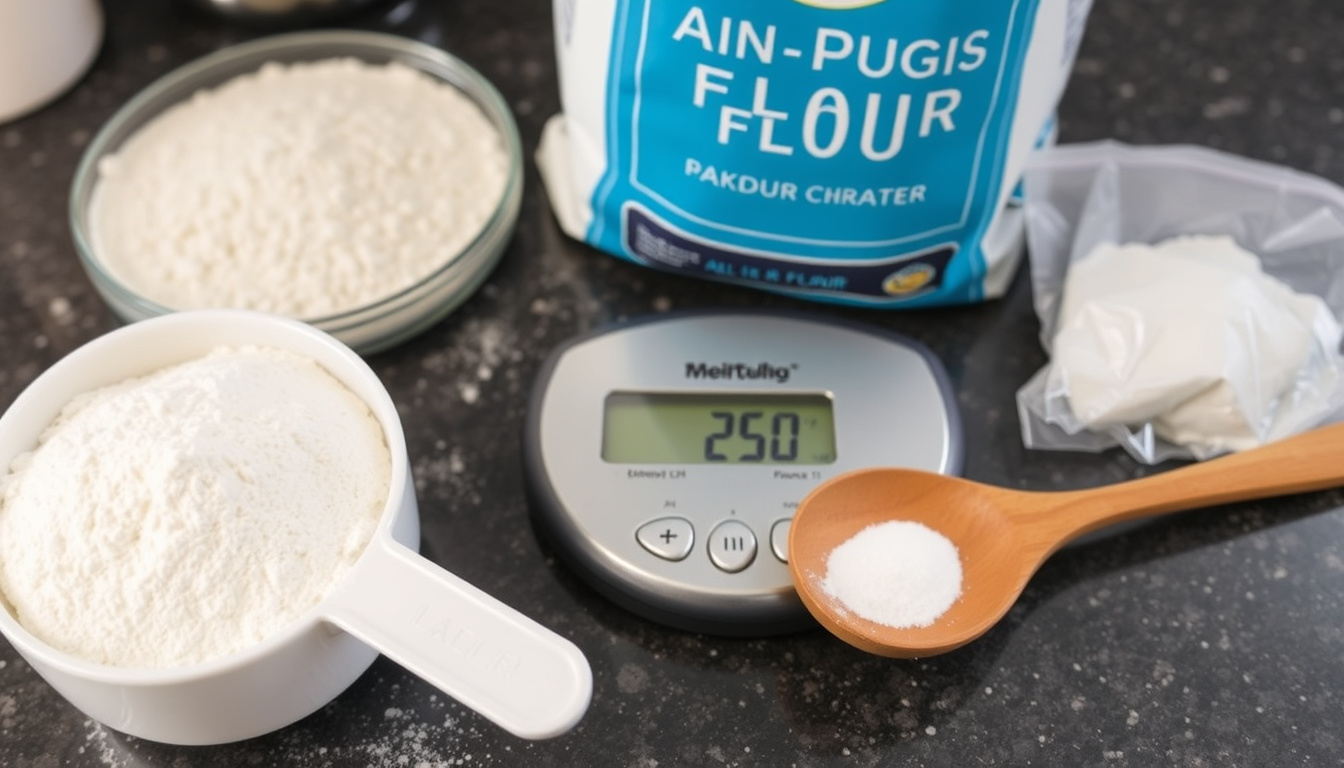

If you’ve ever pulled a floury measuring cup out of the cupboard and wondered whether you’re really adding the right amount, you’re not alone. The difference between 240 g and 250 g may seem small, but in baking it can shift the texture of a loaf or the spread of a cookie.
Standard weight of 2 cups all-purpose flour (King Arthur Baking): 240 g · Standard weight of 2 cups all-purpose flour (Allrecipes): 250 g · 1 cup all-purpose flour (King Arthur Baking): 120 g · 1 cup granulated sugar: 200 g · 1 cup unsalted butter: 227 g · Common scooping vs spoon-level difference: up to 30 g per cup
Quick snapshot
- 1 cup all-purpose flour = 120–125 g (King Arthur Baking ingredient weight chart; Weekend Bakery USDA conversion)
- 2 cups all-purpose flour = 240–250 g (King Arthur Baking ingredient weight chart; Weekend Bakery USDA conversion)
- Scooping adds ~25 g extra per cup vs spoon-and-level (King Arthur Baking ingredient weight chart)
- No universal standard: 250 g is a common estimate, not a fixed rule
- Humidity and flour brand can shift weight by a few grams
- Some recipes assume 2 cups = 250 g without stating the measuring method
- Major references diverge: King Arthur uses 120 g/cup; Allrecipes and USDA use 125 g/cup (King Arthur Baking ingredient weight chart; Weekend Bakery USDA conversion)
- UK cups (250 ml) vs US cups (~237 ml) add another layer of variation (Brownie Heaven conversion tables)
- Adopt a digital scale for all baking (King Arthur Baking recommends weighing)
- If using cups, always spoon-and-level to stay close to 120 g per cup (King Arthur Baking recommends weighing)
Six key reference points show how different sources stack up on common baking ingredients:
| Ingredient | Weight per 1 US cup | Source |
|---|---|---|
| All-purpose flour (King Arthur) | 120 g | King Arthur Baking ingredient weight chart |
| All-purpose flour (Allrecipes/USDA) | 125 g | Weekend Bakery USDA conversion |
| Whole wheat flour (King Arthur) | 113 g | King Arthur Baking ingredient weight chart |
| Flour (sieved, Doves Farm) | 110 g | Doves Farm conversion table |
| Granulated sugar (King Arthur) | 200 g | King Arthur Baking ingredient weight chart |
| Brown sugar, packed (King Arthur) | 220 g | King Arthur Baking ingredient weight chart |
| Powdered sugar (King Arthur) | 120 g | King Arthur Baking ingredient weight chart |
| Unsalted butter (King Arthur) | 227 g | King Arthur Baking ingredient weight chart |
The 240 g vs 250 g split isn’t a mistake—it’s a reflection of two different measurement philosophies. King Arthur’s 120 g/cup assumes a light spoon-and-level; the USDA’s 125 g/cup (used by Allrecipes) reflects a denser, scoop‑based average. Neither is “wrong,” but you must choose one and stick with it.
How many grams is 2 cups of flour?
The short answer: between 240 g and 250 g for all-purpose flour, depending on whose standard you follow. King Arthur Baking, a trusted authority in the US, sets 1 cup at 120 g, making 2 cups exactly 240 g (King Arthur Baking ingredient weight chart). Allrecipes and the USDA round to 125 g per cup, yielding 250 g for 2 cups (Weekend Bakery USDA conversion).
Standard conversion for all-purpose flour
- King Arthur Baking (tier‑1 baking resource): 1 cup = 120 g → 2 cups = 240 g
- Doves Farm (UK flour mill): 1 cup = 120 g → 2 cups = 240 g (Doves Farm conversion table)
- USDA / Allrecipes (US government and major recipe platform): 1 cup = 125 g → 2 cups = 250 g
Variation by flour type (bread, whole wheat, cake)
Different flours pack differently. King Arthur lists whole wheat flour at 113 g per cup, and Doves Farm notes that sieved flour (akin to cake flour) weighs only 110 g per cup (Doves Farm conversion table). Bread flour, with higher protein content, tends to be slightly heavier—around 127 g per cup in many references.
What this means: If your recipe calls for 2 cups of bread flour, using an all‑purpose conversion could throw off your hydration ratio. Always match the flour type to the weight chart you’re following.
The pattern: Consistency beats precision. Pick one reference (e.g., King Arthur’s 120 g/cup) and use it for the entire recipe to keep ratios intact.
Even within all‑purpose flour, a cup measured by scooping can weigh 140–150 g—far above any standard. That 30 g difference per cup is enough to turn a tender scone into a dense hockey puck.
Is 2 cups of flour 250g?
Yes and no. Many recipe blogs list “2 cups flour = 250 g” as a convenient shorthand, and for everyday baking it’s close enough. But it’s an approximation, not a universal truth. The exact weight depends on how you fill the cup.
Why 250g is a common but imprecise number
The 250 g figure likely comes from the USDA’s standard of 125 g per cup, multiplied by 2. However, any weight given in a recipe is only as accurate as the measuring method the author had in mind. If the recipe was developed using a scale, 250 g is exact. If it was developed with a scoop‑and‑sweep method, the “2 cups” might actually weigh 280 g or more.
When 250g might be acceptable
If you’re making a forgiving recipe—like a quick bread or a rustic yeast bread—a 10 g swing per two cups is unlikely to ruin it. For delicate pastries, chiffon cakes, or macarons, that 10 g can mean the difference between a light crumb and a dense one. The safe route: weigh your flour.
The trade-off: Convenience (using 250 g as a default) versus precision (weighing to the gram). For casual baking, choose one reliable source and stick with it. For serious bakers, a scale is non‑negotiable.
How to Measure Flour Properly
If you don’t have a scale, the spoon‑and‑level method is the most consistent way to get close to the 120–125 g per cup range.
Spoon-and-level method step-by-step
- Fluff the flour with a spoon to aerate it.
- Spoon the flour lightly into the measuring cup—don’t pack it.
- Level off the top with a straight edge (e.g., a knife) (King Arthur Baking’s recommendation).
Avoid scooping directly from the bag
Scooping compacts the flour, adding 20–30 % more weight per cup. That can turn 2 cups (240 g) into 300 g—a big enough difference to affect hydration and texture.
Using a kitchen scale for best results
King Arthur Baking explicitly advises, “For best results, we recommend weighing your ingredients with a digital scale” (King Arthur Baking ingredient weight chart). A digital scale eliminates all the variability from cup shapes, humidity, and technique.
Why this matters: A $20 scale is cheaper than a batch of failed pastries. Once you switch, you’ll never go back.
Quick‑Reference Steps for Measuring Flour
When you’re in the kitchen and need a fast reminder, here’s the condensed workflow:
- Weigh 240–250 g of all‑purpose flour for 2 cups (use the standard from your recipe source).
- If using cups: fluff, spoon, level.
- Never scoop directly from the bag.
- For other flours, check a weight chart specific to that flour type.
The pattern: Consistency beats precision. Pick one reference (e.g., King Arthur’s 120 g/cup) and use it for the entire recipe to keep ratios intact.
How many grams is 1 cup of flour?
As established, 1 cup of all‑purpose flour weighs 120 g (King Arthur/Doves Farm) or 125 g (USDA/Allrecipes).
Ratio for scaling recipes
Once you know the per‑cup weight, scaling is straightforward. For example:
- 1 cup all‑purpose → 120–125 g
- 1½ cups → 180–187.5 g
- 3 cups → 360–375 g
Difference between all-purpose and other flours
- Whole wheat flour: 1 cup ≈ 113 g (King Arthur Baking whole wheat weight)
- Bread flour: 1 cup ≈ 127 g (common bakery reference)
- Cake flour (sieved): 1 cup ≈ 110 g (Doves Farm sieved flour)
The implication: Substituting flour types without adjusting weight can throw off your recipe. Always check a weight table for the specific flour you’re using.
How many grams is 2 cups of sugar?
Sugar is more predictable than flour because it’s ground finer and packs less variably. Granulated sugar weighs 200 g per cup (King Arthur Baking sugar weight), so 2 cups = 400 g.
Granulated sugar conversion
- 1 cup = 200 g
- 2 cups = 400 g
- ½ cup = 100 g
Brown sugar and powdered sugar differences
- Brown sugar (packed): 1 cup ≈ 220 g (King Arthur Baking brown sugar weight)
- Powdered sugar (unsifted): 1 cup ≈ 120 g (King Arthur Baking powdered sugar weight)
What this means: If a recipe calls for 2 cups of brown sugar and you substitute granulated by volume, you’ll be short about 40 g—enough to affect sweetness and moisture. Weighing eliminates guesswork.
For a typical baker using 2 cups of granulated sugar per week, the difference between 400 g (by weight) and 400 ml (by volume) is negligible because sugar doesn’t compress like flour. But for flour, that difference is critical. Treat flour conversions with more care.
Confirmed facts
- 1 cup all-purpose flour weighs between 120 g and 125 g depending on source and method
- 2 cups all-purpose flour therefore weighs between 240 g and 250 g
- Scooping flour directly adds roughly 25 g extra per cup compared to spoon-and-level
- Using a kitchen scale eliminates measurement variability
What’s unclear
- Whether 250 g is “correct”—no universal standard exists
- Exact weight can shift with humidity and flour brand
- Some recipes assume 2 cups = 250 g without stating the method
What the Experts Say
“For best results, we recommend weighing your ingredients with a digital scale. A cup of all-purpose flour weighs 120 grams.”
— King Arthur Baking Company (Ingredient Weight Chart)
“All-purpose flour: 1 cup = 125g. Use this chart for accurate conversions.”
— Allrecipes (via Weekend Bakery / USDA data)
“Flour (sieved) 1 cup = 110g.”
— Doves Farm (Cups to Grams Conversion Table)
For the home baker who wants consistent results, the choice is clear: stop using cups for flour and buy a $20 digital scale. Your cakes will rise, your cookies will spread evenly, and you’ll never have to wonder if two cups really means 240 g or 250 g. Weighing isn’t just easier—it’s the only way to guarantee that your flour measurement is the same today, tomorrow, and every time you bake.
Related reading: **53 cm to Inches – Easy and Precise Conversion Guide**
Frequently asked questions
How many grams is 2 cups of bread flour?
Approximately 254 g (based on 127 g per cup). Bread flour is denser due to higher protein content. Always check the weight chart from the recipe source.
Does the type of flour affect the weight per cup?
Yes. Whole wheat flour is lighter (113 g per cup), while bread flour is slightly heavier. Cake flour, if unsieved, is also lighter. Using a dedicated weight chart per flour type is essential.
Why does my flour weigh more than the recipe says?
Most likely because you’re scooping directly from the bag, which compacts the flour. Always spoon-and-level or weigh to match the recipe’s assumed density.
Can I use metric cups (250 ml) instead of US cups (240 ml)?
It can cause a small but measurable difference. A metric cup holds about 10 ml more, which for flour adds roughly 4–5 g per cup. For most recipes the difference is negligible, but for precision baking use the cup standard your recipe assumes.
Is 2 cups of flour the same as 1 pound?
No. 1 pound = 453.6 g. Two cups of all‑purpose flour weigh between 240 g and 250 g, so you’d need roughly 3.6 to 3.8 cups to make a pound.
How do I convert 2 cups of cake flour to grams?
Cake flour is usually lighter. King Arthur Baking lists 1 cup of cake flour at 113 g, so 2 cups ≈ 226 g. If the flour is sieved, Doves Farm gives 110 g per cup (2 cups = 220 g).
What is the best way to measure flour for baking?
Use a digital scale. If you must use cups, always fluff, spoon, and level. Never scoop. Stick to one trusted weight source for all ingredients in the recipe.
Related stories





Jessica Morin covers provincial policy and regional economic trends.