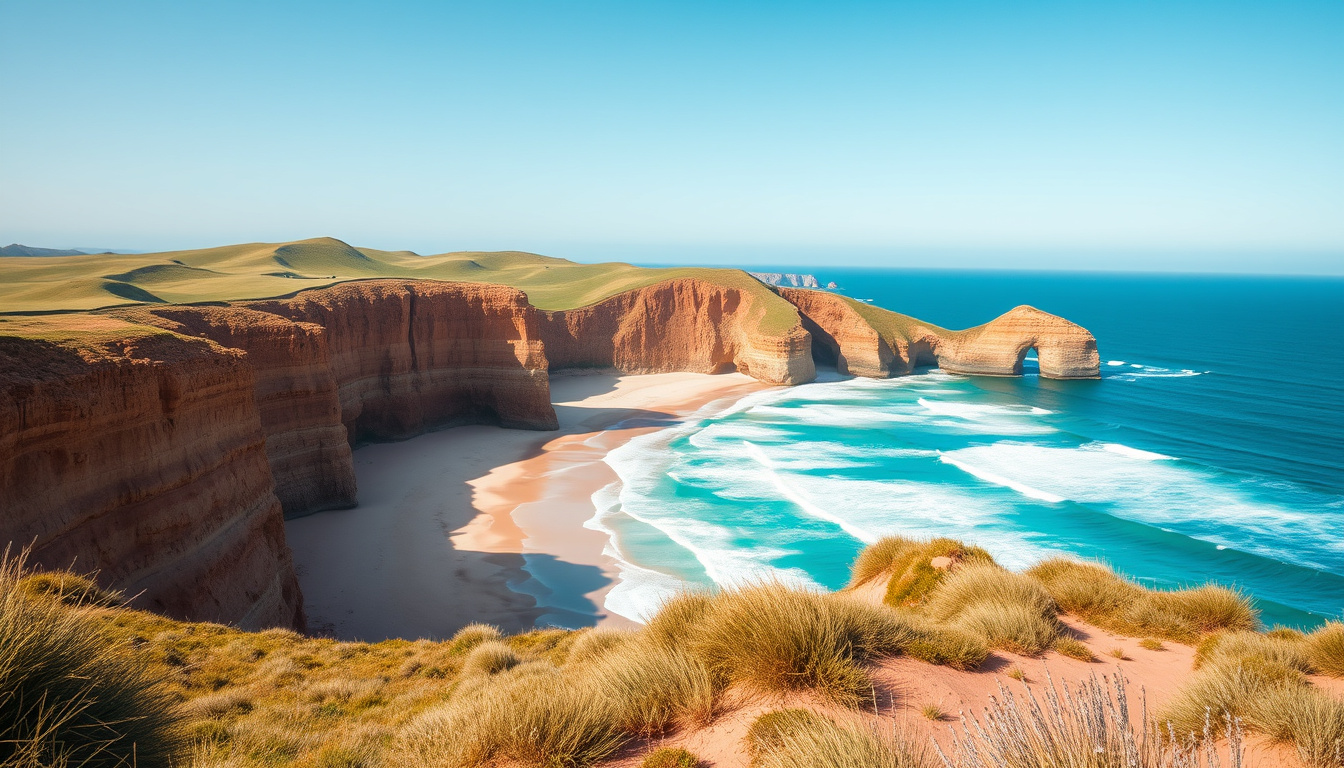
Îles de la Madeleine is a wind-battered archipelago where the effort of reaching it is inseparable from the reward — 12 red-cliffed islands threaded by 85 km of smooth asphalt, where the year-round population of roughly 13,000 triples every summer and the main road passes white-sand beaches and lobster boats on every curve.
Number of islands: 12 ·
Main road length: 85 km (55 miles) ·
Location: Gulf of St. Lawrence ·
Municipalities: 2 since 2005 ·
Official tourism site: tourismeilesdelamadeleine.com
Quick snapshot
- 12 islands in the Gulf of St. Lawrence, population ~13,000 year-round (East Coast Tester)
- 85 km Route 199 connects all six inhabited islands (Quebec Maritime)
- CTMA ferry from Souris, PEI to Cap-aux-Meules takes 5 hours (East Coast Tester)
- Precise 2026 summer ferry fares — the CTMA website shows updated rates that differ from 2023-2024; travelers should verify current pricing directly before booking (Traversier CTMA Official)
- Exact day-by-day budget breakdown varies by season, accommodation tier, and whether you camp or stay in guesthouses (Traversier CTMA Official)
- High ferry season: – (Traversier CTMA Official)
- Toll reductions on Confederation Bridge and Madeleine 2 ferry took effect (Tourisme Îles de la Madeleine)
- Book CTMA ferry early — reservations are required, especially July–August (Tourisme Îles de la Madeleine)
- Decide on itinerary length (3 days minimum, 5–7 days ideal) and whether to prioritize beaches, food trails, or hiking circuits (Tourisme Îles de la Madeleine)
The table below consolidates core logistics for planning a Magdalen Islands visit.
| Fact | Detail |
|---|---|
| Archipelago location | Gulf of St. Lawrence, Canada |
| Island count | 12 |
| Primary road | Route 199, 85 km |
| Municipal structure | 2 municipalities since 2005 |
| Key features | Beaches, red cliffs, regional products |
| Best time | Summer (June–September) |
| Ferry operator | CTMA (Coopérative de Transport Maritime et Aérien) |
| Ferry crossing | 5 hours from Souris, PEI |
What is the best time to visit the Îles de la Madeleine?
Summer is the obvious answer — but there’s more nuance than that. The high season for the CTMA ferry runs from to , when the islands are fully operational and most attractions, restaurants, and tour operators are open (Traversier CTMA Official). Outside that window, services thin out quickly and some operators shut down entirely until the following spring.
Peak season details
July and August draw the largest crowds — the full-time population of roughly 13,000 triples during these months (East Coast Tester). Ferry seats and accommodation fill up weeks in advance. The upside is that all six curated itinerary circuits published by Tourisme Îles de la Madeleine — including the Arts Circuit, Food Trail, and La Grave Audioguided tour — run at full capacity, giving visitors the widest range of options.
Weather patterns
Quebec Maritime describes Îles de la Madeleine as ideal for cycling and hiking along the Sentier du Littoral trail, which passes the Gros-Cap lookout and Saint-Pierre de Lavernière Church. Summer temperatures are mild — typically 15–25 °C — but the islands are fully exposed to Gulf winds, which can shift a beach day into a hiking day without much warning. The wind is part of the character; travelers who dress in layers and plan a backup indoor activity tend to enjoy themselves more.
Off-season advantages
Late May and early October are when the islands feel most like themselves. Crowds vanish, the red cliffs at La Belle Anse are entirely yours, and local seafood shops operate on their own schedule. Ferry fares are lower outside the high-season window. The trade-off is that some restaurants and operators close after mid-September, so pre-planning is essential. For road-trippers who prioritize solitude and don’t need the full summer activity slate, the shoulder season delivers a genuinely different experience.
What to do in the Îles de la Madeleine?
This is where the islands stand apart from other Gulf of St. Lawrence destinations. The combination of red sandstone cliffs, 300 km of white-sand beaches, Acadian food culture, and a low-traffic road network makes Îles de la Madeleine one of the most complete outdoor-and-food road trips in Eastern Canada (East Coast Tester). Here’s how to approach the highlights.
Top activities and attractions
The islands offer four broad categories of experience: beach time, hiking, food trails, and maritime heritage. The Tourisme Îles de la Madeleine itinerary page lists five curated circuits covering arts, food, cycling, and a self-guided trail called Sentiers Entre Vents et Marées, which spans all islands in 13 sections (BRB Travel Blog). Maritime heritage attractions include the Musée de la Mer, which documents the over 500 shipwrecks recorded around the archipelago — a grim but fascinating record of the islands’ treacherous position (Air Canada Vacations).
Road trip highlights
Route 199 is the spine of any island visit. Driving from one end of the archipelago to the other takes around 90 minutes, and the road passes through every major settlement — Cap-aux-Meules (the commercial hub), Havre-aux-Maisons, Havre-Aubert (home of the circular Bassin road with its colourful houses and lighthouses), and Grande-Entrée. The Route Verte bike path runs roughly 100 km alongside the highway, making the islands a serious cycling destination for anyone comfortable on two wheels (BRB Travel Blog). For RVs and camper vans, the islands are particularly well suited — low traffic, short distances, and several overnight parking options.
Beaches and cliffs
The red cliffs of La Belle Anse are the most photographed feature on the islands. The sandstone glows deep orange in afternoon light, and a walking trail runs along the top of the bluff. Nearby, Pointe-aux-Loups has expansive sand dunes, and the Seal Interpretive Center charges approximately $10 for summer entry — a modest fee for a site that reframes how you understand the islands’ relationship with the sea. The northern circuit, as documented by road-trip video creators, includes Cape Alright Lighthouse, Cap Noir, and the Sentier de l’île Boudreau hike, which visitors describe as the best hike on the islands (YouTube Road Trip Part 2). Entry Island, the most secluded of the group, is uninhabited and accessible only by a secondary ferry, making it the reward destination for travelers willing to plan ahead.
Most visitors come for July–August beach weather, but the red cliffs and hiking trails are arguably better in late May or early September when the same landscapes are completely uncrowded. You trade a few degrees of warmth for a quality of silence that high season simply cannot offer.
How many days to visit the Îles de la Madeleine?
The answer depends on how deeply you want to explore — and how much beach time matters to you. Three days is the practical minimum for first-time visitors who want to cross the islands off a list. Five to seven days is where the trip becomes genuinely satisfying, letting you follow one of the curated circuits without rushing past the food shops and viewpoints that make the islands worth the ferry crossing in the first place.
Minimum itinerary
Air Canada Vacations publishes a structured 3-day itinerary that gives a taste of what the islands offer: Day 1 focuses on sea activities and boat or kayak exploration around Cap-aux-Meules, with a stop for lobster poutine; Day 2 covers the history at Le Site D’Autrefois and the heritage shopping district of La Grave; Day 3 takes the secondary ferry to Entry Island for hiking with views of the dramatic red cliffs (Air Canada Vacations). This compressed schedule works, but it leaves little room for weather days or spontaneous detours.
Ideal road trip duration
Travelers with five days tend to split their time across two or three island clusters, following Route 199 to the northern highlights on one day and the southern food trail on another. The BRB Travel Blog details a 4-day itinerary that starts with Cap-aux-Meules exploration — including Étang-du-Nord, Belle Anse, and the Cap-aux-Meule lighthouse — and ends with a sunset at the Dune de l’Ouest. Day 2 covers La Grave’s shopping, beaches, and the flavour trail past Fumoir d’Antan (a smokehouse) and La fromagerie Pied-de-Vent (a local cheese shop) (BRB Travel Blog). This pace feels more aligned with the islands’ rhythm — relaxed, food-forward, and coastal.
Camping considerations
The islands accommodate both tent and RV camping, and the low-traffic road network makes them particularly popular with the Explorer RV Club community, who note that six main islands are linked by dunes, beaches, and bridges — making the whole archipelago accessible from a single base camp (Explorer RV Club). Exact camping duration and fee details vary by site and season; travelers should check directly with individual campgrounds rather than relying on outdated forum posts. Camping adds meaningful savings for longer stays, especially for families.
How long does it take to tour the Îles de la Madeleine?
The short answer: driving the full length of Route 199 takes just over an hour, end to end. But touring — the kind that involves stops at viewpoints, food shops, hiking trails, and beaches — needs more time. Most visitors who drive the full loop with regular stops report spending 90 minutes to two hours on the road itself across a full day.
Road trip timeline
A practical touring day on the islands starts in Cap-aux-Meules, takes Route 199 north to the lighthouse circuit and red cliffs around Havre-Aubert, loops back via the western beaches, and ends in La Grave for an evening meal. The Quebec Maritime road trip guide describes the Sentier du Littoral trail as a highlight — hikers and cyclists share the path along the coast, passing the Gros-Cap lookout before reaching the Saint-Pierre de Lavernière Church, which anchors the historic core of Havre-Aubert. Allow a full day to do this loop properly without rushing between stops.
Key stops
The stops worth blocking time for are not obvious from a standard map. La Grave is the first Acadian settlement on the islands and remains the cultural centre — part heritage district, part working harbour (East Coast Tester). The Fumoir d’Antan smokehouse and La fromagerie Pied-de-Vent cheese shop reward travellers who plan their food stops ahead rather than improvising. The red cliffs at La Belle Anse and the Seal Interpretive Center each deserve at least 45 minutes — longer if the weather is dramatic.
Full loop estimates
For visitors who want to see every major stop documented by Tourisme Îles de la Madeleine — including Entry Island, the northern lighthouse circuit, and the food trail — a realistic estimate is two full touring days at a moderate pace. The islands cover roughly 435 km of coastline, of which about 300 km are white-sand beaches (East Coast Tester), which is far more than any single day can reasonably cover.
Most first-time visitors underestimate how much time each stop genuinely needs. La Grave alone — with its shops, harbour walk, and food trail — can absorb two to three hours if you stop for a proper meal. Build that time into your schedule rather than discovering it mid-trip.
How much does the ferry to the Îles de la Madeleine cost and how long does it take?
The ferry is the defining logistics decision for any visit — it takes five hours from Prince Edward Island, carries vehicles and passengers, and requires advance reservations. The cost structure has a high season and a low season, and there are separate fares for passengers and vehicles.
Tariffs and schedules
The CTMA (Coopérative de Transport Maritime et Aérien) ferry operates year-round from Souris, PEI, departing PEI at 2:00 PM and departing the islands at 8:00 AM, with extra sailings in July and August (Adventurous Kate). The 2023-2024 high-season fares are the most recently verified figures: adults aged 13–59 paid $59.10 one-way, and vehicles up to 21 feet paid $110.15 one-way (Traversier CTMA Official). The 2026-2027 rate page on the CTMA site shows updated figures that differ significantly from these; travelers should check the current rates directly before booking.
Crossing duration
The crossing from Souris, PEI to Cap-aux-Meules takes five hours, making it a substantial commitment compared to the Confederation Bridge route from mainland Quebec (East Coast Tester). The ferry is also the more scenically rewarding approach — several travelers specifically note the moment when Entry Island’s red cliffs appear on the horizon as one of the trip’s most memorable visual moments (East Coast Tester). Budget five hours for the crossing, and consider whether a daytime or overnight sailing suits your arrival plans on the islands.
Booking tips
Reservations are required for the CTMA ferry, particularly during high season — Tourisme Îles de la Madeleine makes this clear. Since August 1, 2025, toll reductions on the Confederation Bridge and the Madeleine 2 ferry have improved the cost picture for mainland Quebec access routes (Tourisme Îles de la Madeleine). Travelers coming from Quebec can compare the ferry cost against bridge tolls to determine the most economical route. Book as early as possible for July and August crossings.
The ferry fare structure appears to be changing — the 2026-2027 rates shown online differ meaningfully from the 2023-2024 figures. Before committing to a budget, confirm the current one-way fare for your passenger category and vehicle length directly at traversierctma.ca.
Upsides
- Compact 85 km road network means no long drives between major attractions
- Five curated itinerary circuits published by official tourism authority provide ready-made structure
- Population triples in summer — island infrastructure is genuinely scaled for visitors
- Low vehicle traffic makes the islands unusually comfortable for RVs and cyclists
- Toll reductions since August 2025 improve mainland access costs
Downsides
- Five-hour ferry crossing requires advance booking and limits spontaneous day-trip access
- High season (mid-June to mid-September) brings significant crowding — accommodation fills early
- Most services and operators close after mid-September
- Current 2026 ferry fares not fully confirmed; travelers need to verify pricing directly
- Strong Gulf winds can disrupt beach plans even in summer months
“You’ll want to be outside on the deck when the first enchanted island of the archipelago, Île d’Entrée, mythical with its steep red cliffs, appears on the horizon.”
— East Coast Tester (Travel Blogger)
“The best hike in the Magdalen Islands, with ocean views and dramatic bluffs.”
— YouTube Road Trip (Video Creator)
Îles de la Madeleine is not a destination you stumble onto — it takes a 5-hour ferry crossing or a long drive across the Confederation Bridge to reach, and that deliberate effort is part of what makes the islands feel like a discovery rather than a package holiday. The reward is 12 islands threaded together by 85 km of road, a food culture built on lobster and local cheese, and red cliffs that genuinely look like nothing else in Eastern Canada. For first-time visitors, five days in summer — booked well ahead — covers the essential highlights without the feeling of a rushed checklist. For travelers who return, the shoulder season reveals a quieter, more personal version of the same landscape.
Planning your island adventure, pair this overview with the comprehensive Îles de la Madeleine guide that dives deeper into ferry routes, seasonal tips, and hidden gems.
Frequently asked questions
What is the most beautiful place in the Îles de la Madeleine?
The red cliffs at La Belle Anse are the most photographed spot on the islands, offering deep orange sandstone views best experienced in the afternoon light. Entry Island, accessible by secondary ferry, is considered by many travelers to be the most dramatic and secluded — described by road-trip content creators as the best hiking destination in the archipelago.
What is the time zone for Îles de la Madeleine?
Îles de la Madeleine follows Atlantic Standard Time (AST/UTC−4), consistent with Prince Edward Island and most of Maritime Canada. During daylight saving time (approximately March–November), the islands switch to Atlantic Daylight Time (ADT/UTC−3).
Where to find a map of Magdalen Islands?
The official Tourisme Îles de la Madeleine website provides interactive itinerary maps covering the five curated circuits, including the Sentiers Entre Vents et Marées trail across all islands. Printed maps are also available at the ferry terminal on arrival.
What towns are in Îles de la Madeleine?
The archipelago is formally organized into two municipalities since 2005, but visitors will encounter several distinct towns and settlements: Cap-aux-Meules (the commercial hub and main ferry port), Havre-aux-Maisons, Havre-Aubert (known for its colourful Bassin circular road and heritage lighthouse circuit), Grande-Entrée, and La Grave (the historic first Acadian settlement). Entry Island remains uninhabited year-round.
What restaurants are in Les Îles de la Madeleine?
La Grave is the main restaurant cluster — a heritage district with seafood-focused menus built around the day’s catch. The flavour trail includes the Fumoir d’Antan smokehouse and La fromagerie Pied-de-Vent local cheese shop, both open to visitors. A lobster poutine — a regional specialty combining fries, cheese curds, and fresh lobster — appears on menus across the islands, particularly in Cap-aux-Meules. Exact restaurant listings and seasonal hours should be confirmed locally on arrival.
How to book accommodation in Iles de la Madeleine?
Accommodation ranges from campgrounds and B&Bs to hotels and vacation rentals, with Cap-aux-Meules and Havre-Aubert offering the highest concentration of options. Tourisme Îles de la Madeleine maintains a directory of verified accommodation providers. During high season (June–September), bookings should be made weeks in advance — some properties fill three to four months ahead of July and August.
Planning a Magdalen Islands camping trip or checking best time to visit Quebec can help round out your itinerary for the region.
Related stories





Catherine Roy is Editor-in-Chief at Northern Focus, overseeing editorial policy, corrections, standards and publication decisions across Canadian regional coverage.