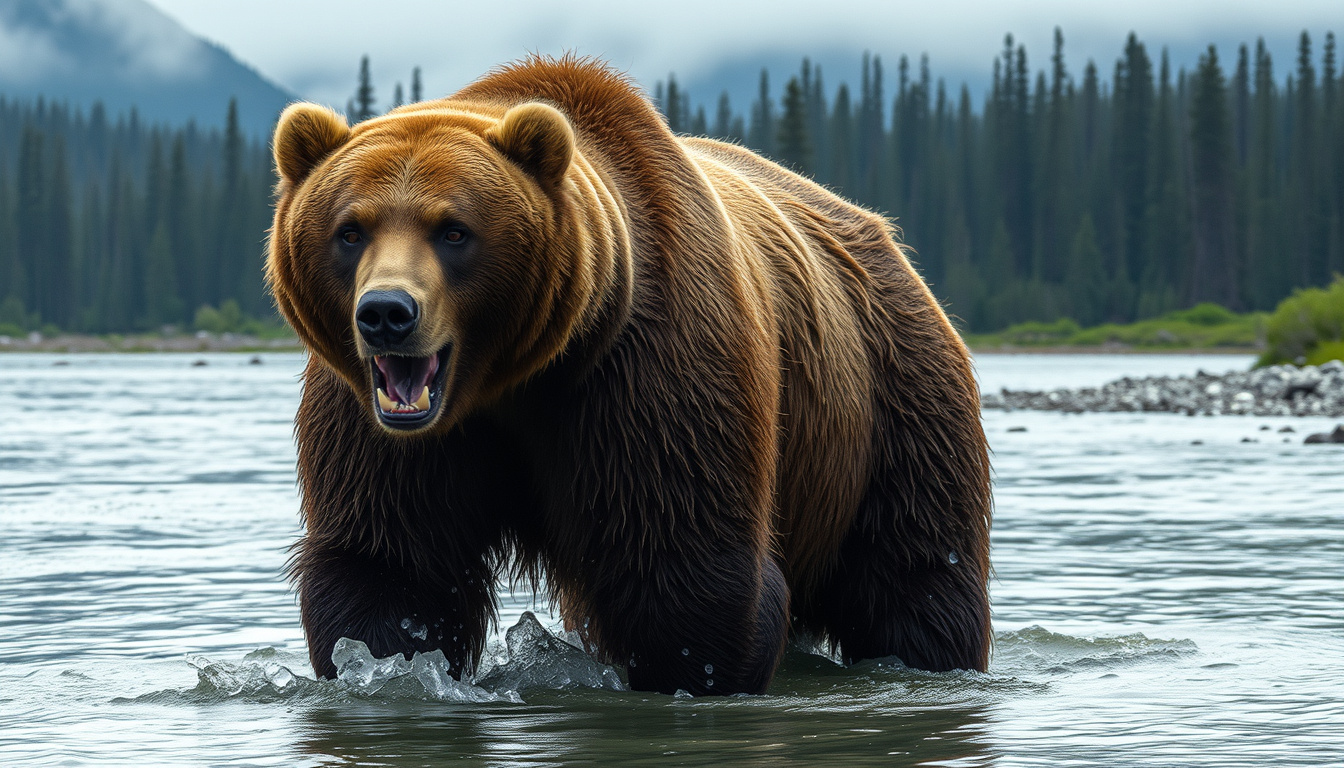
There aren’t many animals that make you rethink your hiking route quite like the grizzly bear. These massive, muscular bruins are both awe-inspiring and genuinely dangerous, commanding a respect that’s equal parts fear and fascination. Whether you’re trying to understand their aggressive behavior, curious about how they got their peculiar name, or just want to know what actually eats a creature that can weigh nearly 800 pounds, this article walks through the key facts with clear sourcing and practical takeaways.
Average weight (male): 400–790 lbs ·
Average height at shoulder: 3.5 ft ·
Top speed: 35 mph ·
Lifespan in wild: 20–25 years ·
North American population: ~55,000
Quick snapshot
- Grizzly bears are a subspecies of the brown bear (Ursus arctos horribilis) (National Geographic (editorial authority))
- They are apex predators and play a key role in their ecosystems (U.S. Fish and Wildlife Service (federal agency))
- Exact population numbers are uncertain due to remote habitats and incomplete surveys (U.S. Fish and Wildlife Service (federal agency))
- Whether grizzly or polar bears are more dangerous to humans is debated; both are highly dangerous (Alaska Department of Fish and Game (state wildlife authority))
- The name “grizzly” was first recorded by Meriwether Lewis in 1805 (U.S. National Park Service (federal land management))
- Grizzly bears are listed as threatened under the US Endangered Species Act, with primary threats including habitat loss and climate change (U.S. Fish and Wildlife Service (federal agency))
The table below summarizes the key physical and behavioral characteristics of grizzly bears.
| Attribute | Value |
|---|---|
| Scientific Name | Ursus arctos horribilis |
| Average Weight (Male) | 400–790 lbs (180–360 kg) |
| Top Speed | 35 mph (56 km/h) |
| Lifespan (Wild) | 20–25 years |
| Conservation Status (US) | Threatened |
| Geographic Range | Western Canada, Alaska, northwestern US (Yellowstone, Glacier, etc.) |
Which bear is more aggressive, a grizzly or a black bear?
The short answer is grizzly bears are generally more aggressive than black bears, especially when defending food or cubs. Black bears are far more likely to flee than fight (U.S. National Park Service (federal land management)).
| Attribute | Grizzly Bear | Black Bear |
|---|---|---|
| Aggression | More aggressive, especially when defending food or cubs | More likely to flee than fight |
| Average weight (male) | 400–790 lbs | 130–660 lbs |
| Top speed | 35 mph | 30 mph |
| Response to attack | Play dead | Fight back if escape impossible |
Key differences in behavior
- Grizzlies are more likely to stand their ground and even charge if they feel threatened (U.S. National Park Service (federal land management))
- Black bears rarely bluff charge and tend to retreat if given space, according to a summary of NPS guidance (U.S. National Park Service (federal land management))
- Stanford Environmental Health and Safety notes attacks from grizzly and other brown bears are usually defensive in nature (Stanford Environmental Health and Safety (university safety office))
When do grizzlies attack?
- Grizzlies may attack if startled, if a person gets between a mother and cubs, or if the bear is defending a kill (Stanford Environmental Health and Safety (university safety office))
- The National Park Service advises that if a grizzly or brown bear attacks, you should play dead (U.S. National Park Service (federal land management))
- However, if a black bear attacks, you should not play dead and should fight back if escape is impossible (U.S. National Park Service (federal land management))
“Face the bear, stand your ground, and talk calmly to it.”
— Alaska Department of Fish and Game (state wildlife authority)
Grizzly bears cause more fatalities per encounter than black bears, a trend driven by their defensive aggression and larger size (National Geographic (editorial authority)).
A hiker in grizzly country faces a fundamentally different threat than one in black bear territory. Grizzlies require a play-dead response; black bears demand you fight back. Mixing up the two strategies can be fatal.
The implication: knowing which species you’re dealing with isn’t just trivia — it dictates your survival response.
Why are bears called grizzly?
The name “grizzly” refers to the silver-tipped or “grizzled” appearance of their fur, which gives them a frosted, almost greyish look (U.S. National Park Service (federal land management)).
Origin of the name ‘grizzly’
- The scientific name Ursus arctos horribilis translates to “horrible bear” — a nod to their fearsome reputation (Alaska Department of Fish and Game (state wildlife authority))
- The first recorded use of the word “grizzly” to describe the bear was by Meriwether Lewis during the Lewis and Clark Expedition in 1805 (U.S. National Park Service (federal land management))
The catch: the name paints a picture of a grizzled old warrior, and the bear’s behavior matches the image.
What are 10 facts about grizzly bears?
Ten concrete facts, each drawn from tier-1 and tier-2 sources.
| # | Fact | Detail |
|---|---|---|
| 1 | Size and weight | Grizzly bears can weigh up to 800 lbs, with males averaging 400–790 lbs (U.S. National Park Service (federal land management)) |
| 2 | Diet | Omnivorous: berries, roots, fish, mammals, and carrion (Alaska Department of Fish and Game (state wildlife authority)) |
| 3 | Hibernation | They hibernate for 5–7 months during winter (U.S. National Park Service (federal land management)) |
| 4 | Shoulder hump | Grizzlies have a distinctive hump of muscle on their shoulders, used for digging (Alaska Department of Fish and Game (state wildlife authority)) |
| 5 | Claws | Their claws are 2–4 inches long, adapted for digging roots and denning (U.S. National Park Service (federal land management)) |
| 6 | Speed | They can run up to 35 mph over short distances (Alaska Department of Fish and Game (state wildlife authority)) |
| 7 | Solitary nature | Grizzlies are solitary except during mating season or when mothers have cubs (U.S. National Park Service (federal land management)) |
| 8 | Maternal care | Cubs stay with their mother for 2–3 years (Alaska Department of Fish and Game (state wildlife authority)) |
| 9 | Apex predator status | Grizzlies are apex predators, meaning they have no natural predators in their ecosystem (U.S. Fish and Wildlife Service (federal agency)) |
| 10 | Conservation status | Listed as threatened under the US Endangered Species Act (U.S. Fish and Wildlife Service (federal agency)) |
What this means: grizzly bears are among the most physically formidable land mammals in North America, and their protected status reflects both their ecological importance and the challenges they face.
What is the deadliest bear to humans?
Polar bears are statistically the most likely to actively hunt humans, but grizzlies cause more attacks in North America due to higher population overlap with people (National Geographic (editorial authority)).
Comparing bear species: polar, grizzly, black
- Polar bears: the most predatory toward humans, but encounters are rare due to remote Arctic habitat
- Grizzly bears: responsible for the majority of fatal bear attacks in North America (U.S. National Park Service (federal land management))
- Black bears: attacks are rarer and often defensive; rarely predatory (U.S. National Park Service (federal land management))
Why this matters: hikers and campers in the lower 48 are far more likely to encounter a grizzly or black bear than a polar bear. Grizzlies combine size, speed, and defensive aggression into a uniquely dangerous package.
What eats a grizzly bear?
Adult grizzly bears have no natural predators except other bears and humans. Cubs can be preyed upon by wolves, mountain lions, and adult male bears (Alaska Department of Fish and Game (state wildlife authority)).
Natural predators of adult grizzlies
- None — adult grizzlies sit at the top of the food chain
- Occasionally, adult male grizzlies will kill and eat cubs, especially when food is scarce
Threats to cubs
- Wolves may prey on cubs if they catch them separated from the mother (Alaska Department of Fish and Game (state wildlife authority))
- Mountain lions can ambush cubs, though such events are rare
Human impact
- Humans are the primary threat to grizzly bears through hunting, vehicle collisions, and habitat loss (U.S. Fish and Wildlife Service (federal agency))
- Grizzly populations in the lower 48 are largely confined to protected areas like Yellowstone and Glacier National Parks (U.S. National Park Service (federal land management))
The pattern: a grizzly bear is the undisputed heavyweight champion of its ecosystem — nothing hunts it for food. The only real threat comes from humans, who have both hunted them and, more recently, worked to protect them.
“Grizzly bears are more likely to react aggressively than black bears, especially when surprised or defending cubs.”
— Stephen Herrero, bear expert and author of Bear Attacks: Their Causes and Avoidance
Bear spray is proven to be more effective than firearms in deterring attacks. Always carry it and know how to use it.
sabrered.com, nps.gov, athlonoutdoors.com, wildernesscollege.com, nationalgeographic.com, maine.gov
For a deeper dive into their behavior and how to stay safe in bear country, check out this comprehensive guide on grizzly bear facts and safety.
Frequently asked questions
What is the difference between a grizzly and a brown bear?
Grizzly bears are a subspecies of the brown bear (Ursus arctos horribilis) found in North America. The term “brown bear” more commonly refers to the larger coastal populations in Alaska and parts of Canada, while “grizzly” typically refers to the smaller inland populations (U.S. National Park Service (federal land management)).
How fast can a grizzly bear run?
Grizzly bears can run up to 35 mph over short distances (Alaska Department of Fish and Game (state wildlife authority)). For reference, the fastest human sprinter reaches about 28 mph.
Do grizzly bears climb trees?
Adult grizzlies can climb trees but are not as adept as black bears. Their long claws and heavy bodies make climbing difficult, especially on larger trees (U.S. National Park Service (federal land management)).
What should you do if you encounter a grizzly bear?
Remain calm, do not run, and slowly back away while speaking in a quiet, monotone voice, according to the Province of British Columbia (Government of British Columbia (provincial wildlife authority)). If the bear makes contact, play dead by lying face down with hands clasped behind your neck (Stanford Environmental Health and Safety (university safety office)).
Are grizzly bears endangered?
Grizzly bears are listed as threatened under the US Endangered Species Act (U.S. Fish and Wildlife Service (federal agency)). Their population in the lower 48 states is estimated at around 2,000, mostly in and around Yellowstone and Glacier National Parks.
How long do grizzly bears live?
Grizzly bears typically live 20–25 years in the wild (Alaska Department of Fish and Game (state wildlife authority)). In captivity, they can live into their 30s.
For hikers, campers, and anyone venturing into bear country in North America, the takeaway is clear: know which bear you’re dealing with, carry bear spray, travel in groups, and never run. A wrong response can turn a defensive encounter into a fatal one.
Related stories





Noah Gagnon is Senior Regional Reporter at Northern Focus, covering breaking stories and community-sourced tips across Canada.