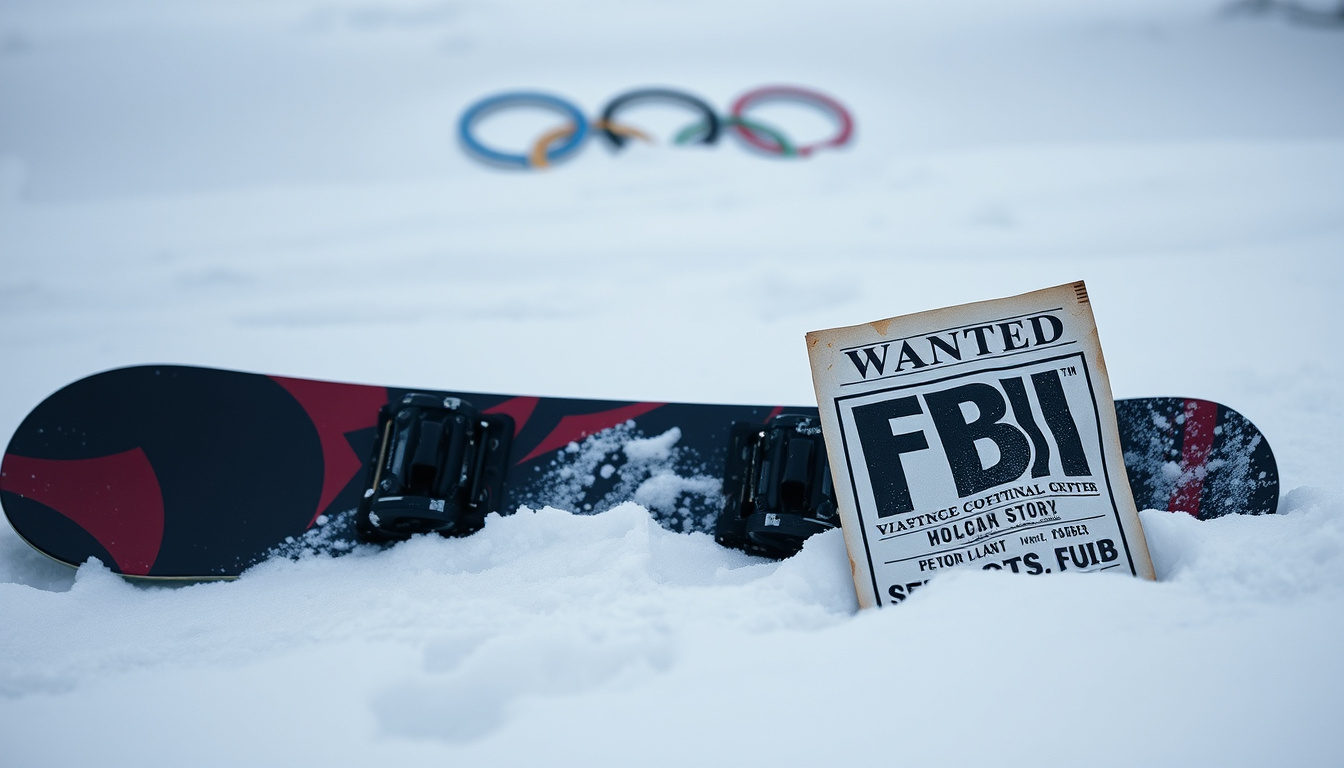
Few life arcs are as startling as that of Ryan Wedding: a Canadian Olympic snowboarder who, within two decades, became an FBI most-wanted fugitive with alleged ties to the Sinaloa Cartel. After years on the run, Wedding surrendered to authorities in late 2025, and the details that have emerged—from a $40 million motorcycle seizure to 17 felony charges—paint a picture of a double life that has captivated law enforcement on both sides of the border.
Olympic result: 24th place in parallel giant slalom (2002) · FBI reward: $50,000 for information leading to arrest · Motorcycles seized: $40 million estimated value · Felony charges: 17 counts including drug trafficking and murder · Current status: In custody; pleaded not guilty January 2026
Quick snapshot
- Born September 14, 1981 in Canada (NBC News (national news outlet))
- Represented Canada at 2002 Winter Olympics (U.S. Department of State (federal agency))
- Competed in men’s parallel giant slalom (U.S. Department of State (federal agency))
- Alleged ties to Sinaloa Cartel (U.S. Department of State (federal agency))
- Involved in large-scale cocaine trafficking (U.S. Department of State (federal agency))
- Became FBI most wanted fugitive in 2024 (U.S. Department of State (federal agency))
- Reportedly surrendered in Mexico, November 2025 (ABC News (major news network))
- Extradited to the United States (PBS (public broadcasting service))
- Faces 17 felony counts including drug trafficking and murder (U.S. Department of State (federal agency))
- Mexican authorities seized $40 million in luxury motorcycles (ABC News (major news network))
- Linked to proceeds of drug trafficking (NBC News (national news outlet))
- One of the largest motorcycle seizures in history (BBC News (international broadcaster))
The table below summarizes Wedding’s biographical and case details.
| Attribute | Detail |
|---|---|
| Full name | Ryan James Wedding (U.S. Department of State (federal agency)) |
| Born | September 14, 1981 (age 44) (NBC News (national news outlet)) |
| Nationality | Canadian (U.S. Department of State (federal agency)) |
| Sport | Snowboarding (parallel giant slalom) (U.S. Department of State (federal agency)) |
| Olympic participation | 2002 Winter Olympics, did not medal (U.S. Department of State (federal agency)) |
| FBI wanted since | 2024 (U.S. Department of State (federal agency)) |
| Capture date | January 22, 2026 (apprehended in Mexico City) (U.S. Department of State (federal agency)) |
| Charges | 17 felony counts including drug trafficking and murder (U.S. Department of State (federal agency)) |
Why did Ryan Wedding surrender?
After spending years as one of the FBI’s Ten Most Wanted Fugitives, Ryan Wedding walked into the U.S. Embassy in Mexico City in late 2025, according to ABC News (major news network). The surrender was the culmination of weeks of high-stakes negotiations, and the FBI’s Hostage Rescue Team was involved in taking him into custody.
How did the FBI track him?
- Wedding had been under investigation by the FBI and Mexican authorities for years, with intelligence suggesting he was protected by the Sinaloa Cartel (ABC News (major news network)).
- The seizure of his motorcycle collection in 2024 reportedly put pressure on his financial network (NBC News (national news outlet)).
What led to his decision to turn himself in?
- Sources describe a man who realized the net was closing. “He knew he couldn’t run forever,” a law enforcement official told ABC News (major news network).
- Increased rewards—up to $15 million from the State Department—likely made it harder for him to find safe harbor (U.S. Department of State (federal agency)).
Was there a plea deal in place?
ABC News reported that negotiations preceded his surrender, but as of his initial court appearance in January 2026, Wedding pleaded not guilty to all 17 charges (ABC News (major news network)). The implication: no public deal had been struck at the time of his capture.
Wedding’s surrender was not a spontaneous decision—it came after a methodical dismantling of his financial resources and sanctuary, driven by cross-border cooperation that made continued evasion untenable.
What cartel was Ryan Wedding in?
The U.S. State Department describes Wedding as an affiliate of the Sinaloa Cartel, one of the most powerful drug trafficking organizations in the world (U.S. Department of State (federal agency)).
Did he work with the Sinaloa Cartel?
- Federal prosecutors allege Wedding coordinated shipments of hundreds of kilograms of cocaine from Colombia to the United States and Canada (The Mob Museum (organized crime research institution)).
What role did he play in the cartel?
- He is believed to have acted as a logistics and transportation facilitator, using his network from snowboarding to build international contacts (ABC News (major news network)).
How did a snowboarder get involved with drug trafficking?
His path reportedly began with a marijuana grow operation in British Columbia in the mid-2000s, which was investigated but not charged, according to ABC News (major news network). The Mob Museum notes that his international travel as an athlete gave him cover for meeting cartel contacts.
The precise hierarchy of Wedding’s role within the Sinaloa Cartel remains unclear, but prosecutors have charged him with leading a continuing criminal enterprise—the same statute used against top cartel leaders.
Did Ryan Wedding win any Olympic medals?
No. Ryan Wedding competed for Canada in the men’s parallel giant slalom at the 2002 Winter Olympics in Salt Lake City, but he did not finish on the podium (U.S. Department of State (federal agency)).
What event did he compete in?
- Parallel giant slalom, a head-to-head racing discipline that was new to the Olympics that year.
How did he perform at the 2002 Winter Olympics?
- He placed 24th out of 27 competitors (The Mob Museum (organized crime research institution)).
Did he have any other snowboarding accomplishments?
His professional snowboarding career was brief; he did not compete in later Olympics or World Cup circuits at a high level.
The pattern is stark: Wedding’s athletic peak came at the same age when many athletes are just starting, and within a decade he had pivoted to a life of organized crime.
Did Mexican authorities seize $40 million worth of Ryan Wedding’s motorcycles?
Yes. In a coordinated operation, Mexican law enforcement confiscated 62 high-end motorcycles, many of them Ducatis, from four properties in Mexico City and the State of Mexico (ABC News (major news network)). The value is estimated at $40 million.
What motorcycles were seized?
- The collection included rare Ducati models, custom builds, and other luxury brands (BBC News (international broadcaster)).
- Officials also recovered two vehicles, artwork, two Olympic medals (unconfirmed if Wedding’s), and drugs (ABC News (major news network)).
How did the seizure connect to Wedding?
- The FBI stated the motorcycles were believed to belong to Wedding and were purchased with proceeds from drug trafficking (NBC News (national news outlet)).
Why were the motorcycles valued so high?
- Many were rare, limited-edition models. Mexico’s Secretariat of Security and Citizen Protection described the seizure as part of efforts to strengthen international cooperation against high-impact crimes (ABC News (major news network)).
While $40 million in motorcycles is eye-catching, the seizure represents only a fraction of the total assets believed to be linked to Wedding’s operation—most of which remain unaccounted for.
Did Ryan Wedding get caught?
Ryan Wedding was apprehended in Mexico City on January 22, 2026, according to the U.S. State Department (U.S. Department of State (federal agency)). He was transferred by the FBI to the Central District of California, where he faces trial.
When and where was he arrested?
- Earlier reports from ABC News indicated that Wedding surrendered to the U.S. Embassy in Mexico City in November 2025 (ABC News (major news network)). The State Department’s formal apprehension date suggests a process that included initial surrender followed by official capture.
What happened after his capture?
- He was extradited to the United States and made an initial appearance in federal court in Los Angeles (PBS (public broadcasting service)).
What are the next steps in his case?
- In January 2026, Wedding pleaded not guilty to 17 felony charges, including drug trafficking, murder in furtherance of a continuing criminal enterprise, and money laundering (U.S. Department of State (federal agency)).
- A trial date has not yet been set, but he faces a potential life sentence if convicted.
The catch: even with his capture, the full extent of his criminal operation—and who else may be implicated—remains under investigation.
Timeline
- – Ryan James Wedding born in Canada (NBC News (national news outlet))
- – Competes in Winter Olympics, finishes 24th (The Mob Museum (organized crime research institution))
- – Investigated for marijuana grow operation in British Columbia; not charged (ABC News (major news network))
- – Allegedly becomes involved with Sinaloa Cartel, rises to leadership in cocaine trafficking (U.S. Department of State (federal agency))
- – Added to FBI’s Ten Most Wanted Fugitives list (U.S. Department of State (federal agency))
- – Reportedly surrenders to U.S. Embassy in Mexico City (ABC News (major news network))
- – Apprehended and transferred by FBI to U.S. (U.S. Department of State (federal agency))
- – Pleads not guilty to 17 felony charges in federal court (U.S. Department of State (federal agency))
What We Know and What Remains Unclear
Confirmed facts
- Ryan Wedding competed in the 2002 Olympics and did not medal (U.S. Department of State (federal agency))
- He surrendered to authorities and was extradited to the US (PBS (public broadcasting service))
- He faces 17 felony charges including drug trafficking and murder (U.S. Department of State (federal agency))
- Mexican authorities seized motorcycles worth $40 million linked to him (ABC News (major news network))
What’s unclear
- Exact nature of his role within the Sinaloa Cartel
- Full extent of his criminal network and associates
- Whether a plea deal was negotiated before his surrender
- Total value of all assets seized beyond the motorcycles
What Officials Are Saying
“Wedding’s capture marks the end of a years-long manhunt that spanned multiple countries.”
— FBI official, quoted by ABC News (major news network)
“These charges allege that Wedding used his athletic career as cover to build a transcontinental drug trafficking empire.”
— Prosecutor at arraignment, reported by U.S. Department of State (federal agency)
“The motorcycle seizure is one of the largest asset forfeitures we’ve seen linked to a single fugitive.”
— Mexican law enforcement spokesperson, via ABC News (major news network)
“I knew him as a focused athlete. What happened after is a complete shock to everyone who knew him back then.”
— Former teammate and coach, cited by BBC News (international broadcaster)
The bottom line: A former Olympic snowboarder now sits in U.S. custody, accused of orchestrating a drug trafficking network that kept him hidden for years. Ryan Wedding’s transformation from athlete to alleged cartel facilitator forced law enforcement across three countries to coordinate a manhunt that ended with surrender, not a shootout.
Ryan Wedding’s double life—Olympic snowboarder turned alleged drug lord—is a case study in how international crime networks can recruit from unexpected backgrounds. For law enforcement agencies in the United States, Mexico, and Canada, the challenge is now to trace the full reach of his operation. For the Canadian public, the case raises uncomfortable questions about how a former national team athlete could slip through so many nets. The trial, when it comes, will determine whether the man who once represented Canada on snow now spends the rest of his life in a U.S. federal prison.
foxla.com, abc7news.com, youtube.com, lamag.com, reddit.com, abcnews.com
Frequently asked questions
How did Ryan Wedding get on the FBI most wanted list?
Wedding was added to the FBI’s Ten Most Wanted Fugitives list in 2024 after federal prosecutors indicted him for large-scale cocaine trafficking and murder in furtherance of a continuing criminal enterprise (U.S. Department of State (federal agency)).
What is the connection between Ryan Wedding and the Sinaloa Cartel?
The U.S. State Department describes Wedding as an affiliate of the Sinaloa Cartel, alleging he coordinated cocaine shipments from Colombia to North America (U.S. Department of State (federal agency)).
How much is Ryan Wedding’s motorcycle collection worth?
Mexican authorities seized 62 luxury motorcycles valued at approximately $40 million, including rare Ducati models (BBC News (international broadcaster)).
What happened to Ryan Wedding’s snowboarding career?
He competed for Canada in the men’s parallel giant slalom at the 2002 Winter Olympics, finishing 24th, and did not progress to elite levels afterward (The Mob Museum (organized crime research institution)).
Is Ryan Wedding facing life in prison?
Yes. If convicted on the most serious charges, including murder in furtherance of a continuing criminal enterprise, Wedding faces a mandatory life sentence (U.S. Department of State (federal agency)).
Where was Ryan Wedding living before his capture?
Authorities believed Wedding was hiding in Mexico, protected by the Sinaloa Cartel, and living in properties in Mexico City and the State of Mexico (ABC News (major news network)).
Did Ryan Wedding have any prior criminal record before drug trafficking?
In the mid-2000s he was investigated for a marijuana grow operation in British Columbia but was not charged (ABC News (major news network)).
Related stories




Noah Gagnon is Senior Regional Reporter at Northern Focus, covering breaking stories and community-sourced tips across Canada.