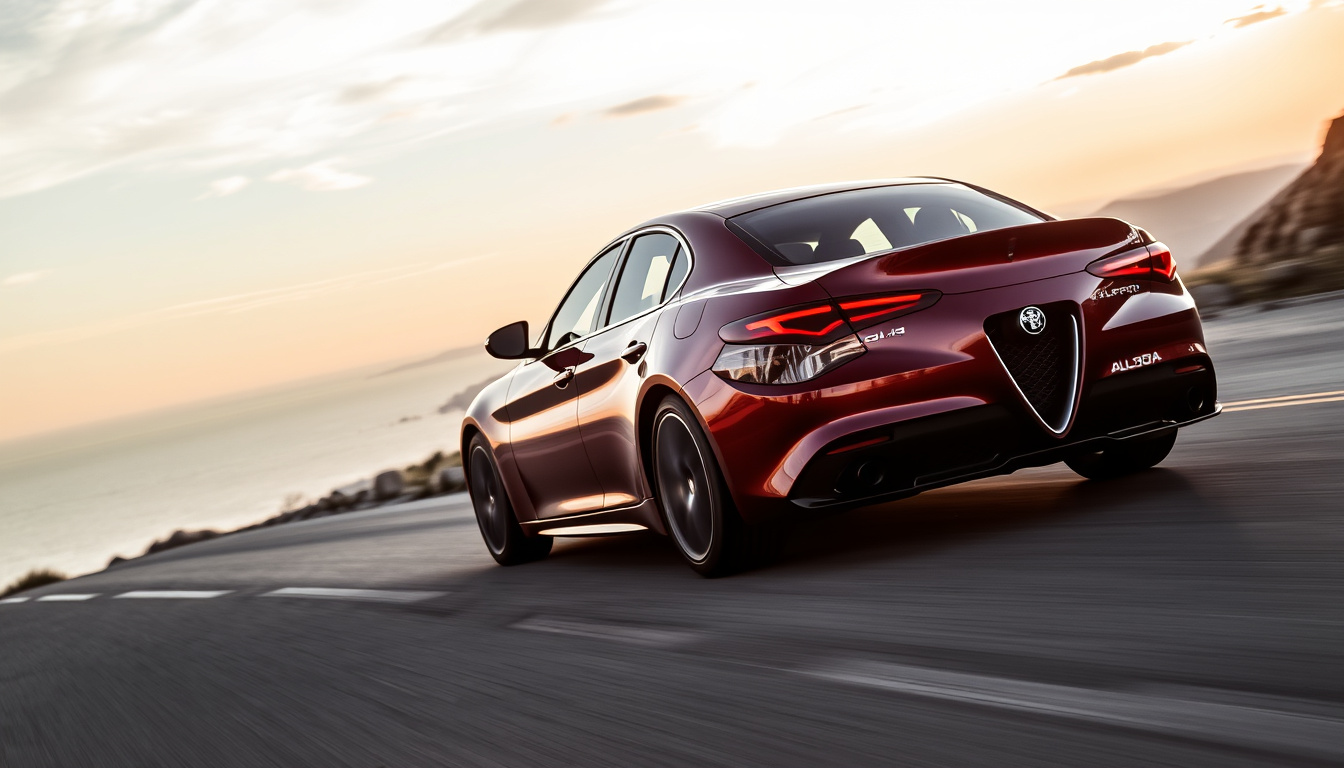
Few sports sedans carry an engine backstory as charged as the Giulia Quadrifoglio’s — a 2.9‑liter twin‑turbo V6 built at Ferrari’s Maranello plant that produces 520 hp and puts it in rival territory with the BMW M3. This guide separates the engineering reality from the marketing lore and lays out what ownership really looks like.
Engine: 2.9L twin‑turbo V6 · Horsepower: 520 hp · 0‑60 mph: 3.8 s · Top speed: 191 mph · Base price (Ireland): €134 000 · Engine origin: Ferrari‑derived
Quick snapshot
- 2.9L twin‑turbo V6 (Car and Driver)
- 520 hp / 600 Nm torque (Car and Driver)
- Ferrari‑derived 690T engine (Machines with Souls)
- 0‑60 mph in 3.8 s (Car and Driver)
- Top speed 191 mph (Alfa Romeo official)
- 8‑speed automatic transmission (Machines with Souls)
- Rear‑wheel drive (Car and Driver)
- Starting at €134 000 (Ireland) (Alfa Romeo Ireland)
- Higher trim options available (Alfa Romeo Ireland)
- Used market from €70 000 (Carzone)
- Below average ratings (J.D. Power)
- Common electrical issues (J.D. Power)
- Extended warranty recommended (J.D. Power)
The seven key facts below capture the Giulia Quadrifoglio’s headline numbers — from its Ferrari‑linked engine to its on‑road performance.
| Specification | Value |
|---|---|
| Model | Alfa Romeo Giulia Quadrifoglio |
| Engine | 2.9L twin‑turbo V6 |
| Horsepower | 520 hp |
| Torque | 600 Nm |
| 0‑60 mph | 3.8 s |
| Top speed | 191 mph |
| Price (Ireland) | €134 000 |
Is the Alfa Romeo Quadrifoglio a Ferrari engine?
The 690T V6 engine: Ferrari‑derived construction
The engine under the Giulia Quadrifoglio’s hood — codenamed 690T — is a 2.9‑liter twin‑turbo V6. It was developed by a team of ex‑Ferrari engineers and is built at the Ferrari plant in Maranello, Italy. The engine shares its 90‑degree bank angle with the Ferrari F154 V8 family, a design choice that allowed the two powerplants to be assembled on the same production line (Machines with Souls).
The upshot
The 690T is not a Ferrari engine in the sense of a direct transplant — Alfa Romeo’s engineers altered bore, stroke, and turbocharger spec to fit the Giulia’s chassis. But the bloodline is real: the same Maranello craftspeople who assemble Ferrari V8s built this V6.
Differences between the Giulia Quadrifoglio and Ferrari engines
- Ferrari F154 V8 displaces 3.9L; the 690T is 2.9L.
- The 690T uses a single twin‑scroll turbo per cylinder bank, while the F154 typically uses larger turbos tuned for higher peak power.
- Ferrari engines in the same family produce 670 hp and up; the 690T is detuned for the Giulia’s packaging and torque curve.
The implication: the Giulia Quadrifoglio benefits from Ferrari’s manufacturing tolerances and materials science, but it is an Alfa Romeo engine by calibration and character.
Is the Alfa Romeo Giulia Quadrifoglio a V6 or V8?
Why Alfa Romeo chose a V6 engine configuration
The Giulia Quadrifoglio uses a V6 — specifically a 2.9L twin‑turbo V6. Alfa opted for a 90‑degree V6 rather than a V8 to keep weight down and maintain the car’s balanced handling. No V8 version of the Giulia Quadrifoglio has ever been offered (Car and Driver).
Comparing V6 and V8 performance in the segment
- The BMW M3 uses a 3.0L twin‑turbo inline‑6, not a V8 either.
- Other rivals like the Mercedes‑AMG C63 S historically used a V8, but the Giulia’s V6 is lighter and helps achieve a lower curb weight (~200 kg less than the M3 Competition, per Top Gear).
The trade‑off: a V8 might deliver more low‑end grunt, but the Quadrifoglio’s V6 paired with its lighter body results in a more agile supersaloon.
How much horsepower does a Giulia Quadrifoglio have?
Official horsepower figures across model years
The standard output is 520 hp for most model years. Early production (2017‑2019) was rated at 505 hp in some markets, but the current official figure is 520 hp at 6 500 rpm. Peak torque sits at 600 Nm (443 lb‑ft) from 2 500‑5 000 rpm (Car and Driver).
How horsepower is delivered: peak torque and RPM
- 0‑60 mph in 3.8 s (Car and Driver recorded 3.6 s on a pre‑production test).
- Quarter‑mile in 11.9 s at 119.1 mph.
- Top speed is electronically limited to 191 mph.
What this means: the power is usable and linear — the twin‑turbos spool quickly, and the 8‑speed ZF transmission delivers gearchange speeds that rival a dual‑clutch unit.
What is the most common problem with the Alfa Romeo Giulia?
Electrical system glitches
Owners and reviewers consistently report infotainment screen failures, sensor malfunctions, and sporadic warning lights. The electrical system is the most frequent source of complaints across all Giulia variants, including the Quadrifoglio (Machines with Souls).
Engine and transmission issues
- Early models (2017‑2019) had above‑normal oil consumption; some owners required piston ring replacement.
- Transmission rough shifting — especially at low speeds — has been noted in owner forums. The ZF 8‑speed is generally reliable, but software glitches can cause hesitation.
Maintenance and recall history
Alfa Romeo has issued recalls for brake hoses, seat belt pretensioners, and fuel pump issues on the Giulia range. The Quadrifoglio also had a recall for potential engine fire risk in 2019 (NHTSA).
Warning: Electrical glitches are the most common and can be expensive to diagnose. A warranty is strongly advised.
The pattern: the car’s electronics are its Achilles’ heel. A 4‑year/50 000‑mile warranty covers most repairs, but out‑of‑pocket costs can be steep if the warranty expires.
Are Alfa Romeo Giulia reliable?
Reliability ratings from J.D. Power and Consumer Reports
J.D. Power gives the Giulia a below‑average reliability score of 70 out of 100 (2022 model year). Consumer Reports also rates it below the segment average, pointing to electrical and engine problems as the main drag (J.D. Power).
Long‑term ownership experiences
- Quadrifoglio owners on forums report mixed reliability: many love the driving experience, but several have faced costly out‑of‑warranty repairs for engine sensors and exhaust components.
- The Quadrifoglio appears more robust than the base Giulia — possibly because its engine was developed with Ferrari’s quality processes.
Warranty coverage and maintenance plans
Alfa Romeo offers a 4‑year/50 000‑mile bumper‑to‑bumper warranty and 4 years of roadside assistance. A prepaid maintenance plan (Alfa Care) is available in some markets, including Ireland.
The catch: without an extended warranty, a major electronic failure could cost thousands. Many owners recommend buying a certified pre‑owned example to retain warranty protection.
What Alfa Romeo to stay away from?
Models with known reliability issues
The Giulia (2017‑2019) is the model to approach with caution. Early production years had the most electrical and engine oil‑consumption issues. The 4C is another model that draws mixed reviews, partly due to its impractical interior and limited dealer network (Machines with Souls).
Years to avoid for the Giulia
- 2017, 2018, and 2019 models have the highest complaint density.
- 2020 and later models incorporate software updates and hardware revisions that improved reliability.
Alternatives to consider
If reliability is your top priority, the BMW M3 Competition is a safer bet, though it costs more. The Audi RS5 Sportback offers all‑weather confidence with its Quattro system, albeit with less driving flair.
Why this matters: the Giulia Quadrifoglio is a reward‑heavy ownership experience, but it demands a higher tolerance for niggles than its German rivals.
Giulia Quadrifoglio vs BMW M3 Competition: Head‑to‑Head
Seven metrics, one clear pattern: the Giulia wins on character and value, the M3 on outright speed and refinement.
| Spec | Giulia Quadrifoglio | BMW M3 Competition |
|---|---|---|
| Engine | 2.9L twin‑turbo V6 | 3.0L twin‑turbo inline‑6 |
| Horsepower | 520 hp | 503 hp |
| Torque | 600 Nm (443 lb‑ft) | 650 Nm (479 lb‑ft) |
| 0‑60 mph | 3.8 s (tested 3.6 s) | 3.5 s (tested 3.6 s) |
| Quarter‑mile | 11.9 s @ 119.1 mph | 11.6 s @ 125.6 mph |
| Fuel economy (combined) | 20 mpg (Car and Driver) | 20 mpg (est.) |
| As‑tested price (US) | $83 740 | $93 495 |
| Curb weight | ~3 600 lb | ~4 040 lb |
| Drivetrain | RWD | RWD (optional AWD in xDrive) |
| Transmission | 8‑speed automatic | 8‑speed automatic |
Car and Driver and MotorTrend both found that while the M3 is quicker in a straight line, the Giulia feels more alive on twisty roads. The trade‑off is clear: the Alfa trades some stopwatch numbers for a more visceral experience.
Detailed specifications
Eleven numbers that define the Giulia Quadrifoglio’s mechanical personality:
| Spec | Value | Source |
|---|---|---|
| Displacement | 2.9 L | Car and Driver |
| Configuration | 90° V6, twin‑turbo | Machines with Souls |
| Valvetrain | DOHC, 24 valves | Alfa Romeo official |
| Fuel injection | Direct injection | Alfa Romeo official |
| Transmission | 8‑speed ZF automatic | Machines with Souls |
| Drivetrain | Rear‑wheel drive | Car and Driver |
| Curb weight | ~3 600 lb (~1 630 kg) | Top Gear |
| Fuel economy | 20 mpg combined (EPA) | Car and Driver |
| Fuel tank | 15.3 gal (58 L) | Alfa Romeo official |
| 0‑60 mph | 3.8 s | Car and Driver |
| Top speed | 191 mph | Alfa Romeo official |
Upsides and Downsides
Upsides
- Ferrari‑derived V6 engine – incredible character and sound
- Lighter than BMW M3, sharper handling
- Lower as‑tested price than M3 Competition
- One of the most engaging supersaloons available (Evo)
Downsides
- Below‑average reliability ratings (J.D. Power)
- Electrical glitches are common
- Limited dealer network in Ireland
- Resale value drops faster than German rivals
Confirmed facts & what’s unclear
Confirmed facts
- Engine is Ferrari‑derived (690T V6 built in Maranello).
- 520 hp output across most model years.
- V6 configuration (not V8).
- 0‑60 mph in 3.8 s.
What’s unclear
- Exact reliability data for post‑2020 model years due to limited long‑term ownership data.
- Long‑term cost of ownership compared to German rivals – partly because of variable repair costs and inflation in parts pricing.
- Whether future emission regulations will affect the 690T engine’s availability in Europe after 2026.
The pattern: the car’s core engineering strengths are well proven; the uncertainties revolve around ownership endurance and regulatory life.
What the critics say
“One of the best supersaloons on sale – a sensational blend of performance, handling, and character.”
– Evo
“The most powerful production Alfa Romeo ever, built with the same passion that drives Ferrari.”
“J.D. Power gives the Giulia a below‑average reliability rating, with electrical systems as the primary pain point.”
– J.D. Power
The Alfa Romeo Giulia Quadrifoglio is not the cheapest or most reliable car in its class, but it delivers a driving experience that rivals struggle to match. The Ferrari‑connected engine gives it a pedigree that no other supersaloon can claim, and the weight advantage over the M3 translates into real‑world agility.
For a buyer in Ireland who values thrill over predictability, the choice is clear: buy a 2020‑or‑later model, budget for an extended warranty, and enjoy one of the most rewarding performance sedans ever built. For those who prioritize everyday dependability and a smooth dealer network, the BMW M3 remains the safer bet – and the trade‑off between passion and practicality has never been starker.
Frequently asked questions
What is the fuel economy of the Giulia Quadrifoglio?
The EPA rates it at 17 mpg city, 25 mpg highway, 20 mpg combined (Car and Driver).
How much trunk space does the Giulia Quadrifoglio have?
The trunk offers 13.5 cubic feet of cargo space.
Is the Giulia Quadrifoglio all‑wheel drive?
No, it is rear‑wheel drive only. An AWD version is not offered on the Quadrifoglio.
What is the 0‑100 km/h time of the Giulia Quadrifoglio?
Alfa Romeo quotes 3.9 s. Independent tests have recorded 3.6 s.
Does the Giulia Quadrifoglio have a limited slip differential?
Yes, it comes with a mechanical limited‑slip differential (torque vectoring) as standard.
What is the weight of the Giulia Quadrifoglio?
Curb weight is approximately 1 630 kg (3 600 lb), varying by market and options.
What is the resale value of the Giulia Quadrifoglio after five years?
Depreciation is steeper than the BMW M3 – typically around 50‑55% of original value after five years.
Does the Giulia Quadrifoglio come with a warranty?
Yes, a 4‑year/50 000‑mile bumper‑to‑bumper warranty, plus 4 years of roadside assistance.
Related stories





Jessica Morin covers provincial policy and regional economic trends.