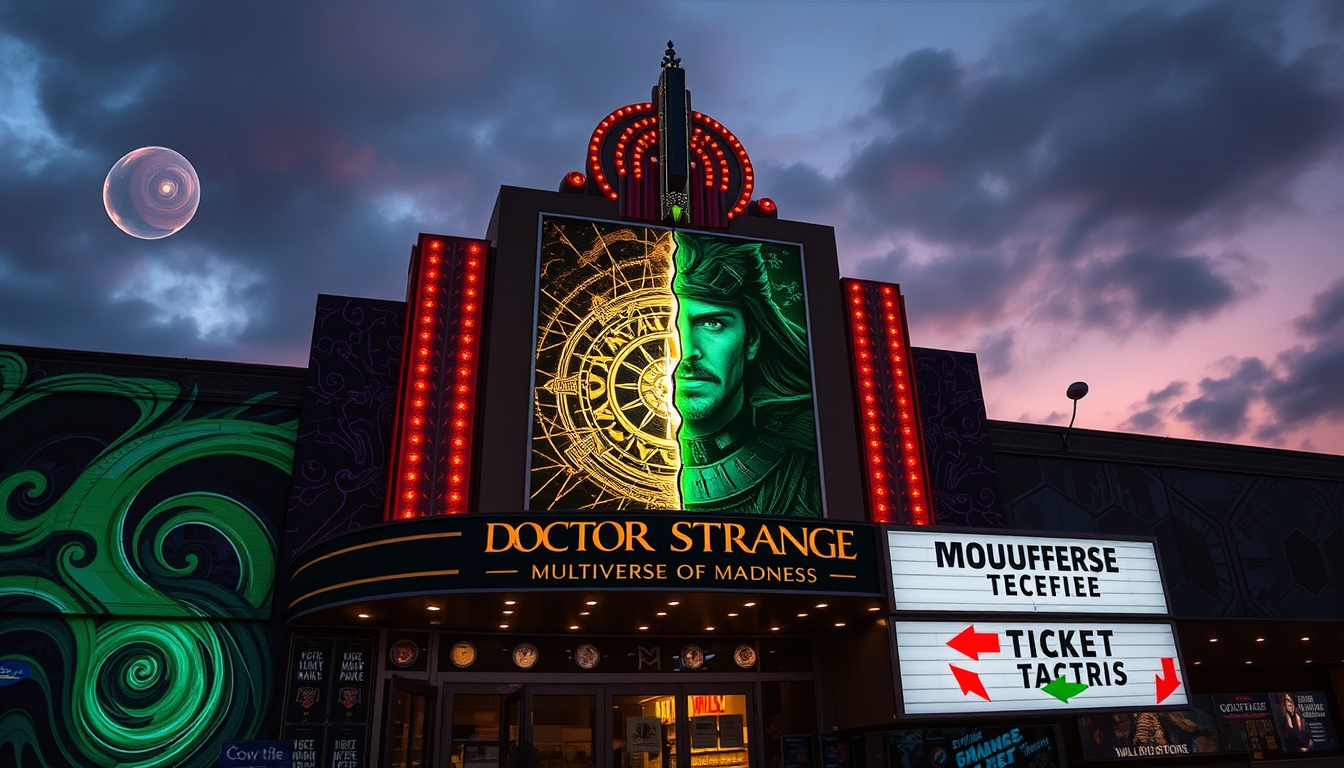

Few Marvel sequels have sparked as much debate as Doctor Strange in the Multiverse of Madness. Released in May 2022, the film shattered opening weekend records with $187 million domestically, yet it also divided audiences and critics alike.
Worldwide Box Office: $955 million ·
Production Budget: $200 million ·
Rotten Tomatoes Critic Score: 74% ·
Audience Score (RT): 71% ·
Metacritic Score: 60/100 ·
Opening Weekend (Domestic): $187 million
Quick snapshot
- Directed by Sam Raimi (Marvel.com)
- Worldwide gross: $955 million (The Numbers)
- Critic score on Rotten Tomatoes: 74% (Rotten Tomatoes)
- America Chavez is an LGBTQ+ character (Marvel.com)
- Official confirmation of Doctor Strange 3 (The Numbers)
- Exact meaning of the third eye (subject to interpretation) (The Numbers)
- Detailed box office break‑even calculation (The Numbers)
- Announced at San Diego Comic‑Con: July 2019 (Marvel.com)
- Filming began: November 2020 (Marvel.com)
- Director Scott Derrickson exited: April 2021 (Marvel.com)
- Theatrical release: May 6, 2022 (Box Office Mojo)
- Released on Disney+: June 2022 (Marvel.com)
- No official Doctor Strange 3 confirmation as of 2024
- Benedict Cumberbatch has expressed interest in returning
- Post‑credits scenes tease future storylines
The nine key facts below paint a fuller picture of the film’s performance and production.
| Attribute | Value |
|---|---|
| Release date | May 6, 2022 |
| Director | Sam Raimi |
| Lead actor | Benedict Cumberbatch |
| Budget | $200 million |
| Box office | $955 million (worldwide) |
| Runtime | 126 minutes |
| Rotten Tomatoes (critics) | 74% |
| Rotten Tomatoes (audience) | 71% |
| Metacritic | 60/100 |
The contrast between critic and audience scores hints at the polarized reception that would fuel much of the film’s debate.
Was Multiverse of Madness a flop?
Doctor Strange in the Multiverse of Madness earned $955 million worldwide against a production budget of $200 million. Industry sources generally estimate the break‑even point for a Marvel film at $500–600 million, meaning the movie turned a tidy profit. Its domestic opening weekend of $187,420,998 was one of the highest of 2022 (Box Office Mojo). The Numbers reports that opening weekend accounted for 45.6% of its total domestic gross, giving it a “legs” ratio of 2.19—a decent but not exceptional hold (The Numbers).
By any traditional box‑office measure, calling the film a flop is inaccurate. Yet the term stuck in online discourse, partly because of the high expectations set by prior MCU sequels. At the time of release, it was the lowest‑grossing sequel in the MCU, though still a blockbuster by any standard.
What is the biggest flop of Marvel?
When fans ask about Marvel’s biggest flop, they’re usually pointing to films like The Marvels (2023), which grossed only $206 million worldwide, or Eternals (2021) with a $402 million haul. By comparison, Doctor Strange 2 sits comfortably in the top‑grossing tier of MCU films. The label “flop” here is more about perceived disappointment relative to hype than actual financial failure.
Financially, Doctor Strange in the Multiverse of Madness was a hit. But for a franchise where sequels often double their predecessor’s take, the $955 million figure felt like a missed opportunity—especially given the multiverse concept’s enormous potential box‑office ceiling.
Why is Dr. Strange: Multiverse of Madness so bad?
Critics and audiences who disliked the film point to pacing problems, underdeveloped characters, and an over‑reliance on horror elements. The Rotten Tomatoes consensus calls it “ambitious but messy” (Rotten Tomatoes).
- Pacing and tone shifts – Sam Raimi’s horror style is a jarring departure from the typical MCU tone, and the film careens from campy humor to grisly violence.
- Character arcs – Elizabeth Olsen’s Wanda Maximoff is transformed into a villain in a way that many found inconsistent with WandaVision (Rotten Tomatoes).
- Creative turnover – Original director Scott Derrickson exited due to “creative differences” with Marvel (Marvel Entertainment YouTube). Raimi brought his own vision, but the change mid‑production may have contributed to the uneven feel.
Metacritic’s “mixed or average” score of 60/100 reflects genuine division among mainstream reviewers (Metacritic). The film’s 71% audience score on Rotten Tomatoes is notably lower than the MCU average, suggesting that the criticisms resonated with regular moviegoers.
The same horror elements that drove audiences away for some were exactly what attracted others. Multiverse of Madness is one of the most divisive Marvel films precisely because it dared to be different—and that risk didn’t land for everyone.
Who is the LGBTQ character in Doctor Strange?
The major new superhero introduced in the film is America Chavez, portrayed by Xochitl Gomez. Marvel identifies her as one of the first openly LGBTQ+ characters in the MCU (Marvel.com). In a brief flashback, she is shown with two mothers, making her queerness explicit but giving it minimal screen time.
This representation generated significant discussion. A common criticism was that the film included LGBTQ representation without giving it enough narrative weight (Polygon). Inverse reported that the flashback is so quick that many viewers missed it entirely (Inverse). Furthermore, some international versions reportedly cut or edited those references, a broader issue Marvel has faced in certain markets (BBC News; Reuters).
Director Sam Raimi stated the representation was intentional, but the execution left many feeling it was tokenistic rather than meaningful.
For a studio that markets itself as inclusive, the treatment of America Chavez—reduced to a few seconds of a flashback and cut in some markets—raises questions about whether Marvel is willing to commit to LGBTQ representation beyond symbolic gestures.
Is Dr. Strange 3 confirmed?
As of 2024, Marvel Studios has not officially announced Doctor Strange 3. However, rumors and reports suggest a sequel is in early development. Benedict Cumberbatch has expressed interest in returning, and the post‑credits scene—featuring Clea (Charlize Theron) recruiting Strange to fix an incursion—clearly sets up a future storyline (Marvel.com).
The lack of an official green light is not unusual; Marvel typically takes years between sequels. Given the film’s strong financial performance, a third installment is widely expected, but nothing is certain until Marvel makes an announcement.
What’s with Dr. Strange’s 3rd eye?
Near the end of the film, Doctor Strange gains a third eye after using the Darkhold, the book of dark magic. The eye is a symbol of corruption and dangerous knowledge—a visual marker that Strange has been touched by forbidden power. Earlier in the film, the Scarlet Witch also displays a third eye after being corrupted by the same book.
In the comics, Strange gains a third eye after using similar dark magic, so the film draws directly from the source material. The exact meaning is left somewhat open to interpretation, but it clearly signals that Strange is now carrying a burden that will affect him in future stories.
Pros and Cons of Doctor Strange in the Multiverse of Madness
Upsides
- Financially successful: $955 million global gross
- Unique horror aesthetic from Sam Raimi
- Introduced America Chavez, a fan‑favorite character
- Strong opening weekend performance
Downsides
- Polarizing reception, especially among core MCU fans
- Underdeveloped characters, especially Wanda’s motivation
- Minimal LGBTQ representation despite promises
- Creative turmoil behind the scenes
The trade-off is clear: the film’s financial success is undeniable, but its legacy is tarnished by missed opportunities in storytelling and representation.
Key Facts and Unclear Aspects
Confirmed facts
- Release date: May 6, 2022 (Box Office Mojo)
- Director: Sam Raimi (Marvel.com)
- Box office: $955 million worldwide (The Numbers)
- Rotten Tomatoes score: 74% critic, 71% audience (Rotten Tomatoes)
- Third eye appears after using Darkhold (Marvel.com)
What’s unclear
- Official confirmation of Doctor Strange 3
- Exact meaning of third eye (ambiguity in script)
- Detailed box office break‑even calculation
- Full impact of Scott Derrickson’s exit on the final product
What the Cast and Crew Say
“I wanted to make a scary Marvel movie.”
– Sam Raimi, director (Marvel Entertainment YouTube)
“It’s a mark of corruption from using the Darkhold.”
– Benedict Cumberbatch, actor (Marvel.com)
“Creative differences with Marvel.”
– Scott Derrickson, original director (Marvel Entertainment YouTube)
The filmmaker’s own words underscore the tension between ambition and execution that defines this controversial sequel.
Bottom line: Doctor Strange in the Multiverse of Madness is a financial success that fell short of its creative potential. For viewers seeking a big‑budget spectacle with a horror twist, it delivers. For those hoping for a coherent multiverse story or meaningful LGBTQ representation, the film leaves them wanting. The implication for Marvel is clear: financial wins can no longer mask storytelling and representation gaps—especially when audiences are paying closer attention than ever.
For a deeper look at how the film performed at the box office, check out this Doctor Strange in the Multiverse of Madness analysis that examines whether it was a hit or a flop.
Frequently asked questions
What is the plot of Doctor Strange in the Multiverse of Madness?
Doctor Strange must protect America Chavez, a teenager who can travel between universes, from the Scarlet Witch, who seeks to steal her power to reunite with her children.
How does the film connect to WandaVision?
The film directly continues Wanda Maximoff’s arc from WandaVision, where she loses her family and becomes corrupted by the Darkhold.
Who is the villain in Doctor Strange 2?
The primary antagonist is Wanda Maximoff / the Scarlet Witch, driven by grief and dark magic.
What are the post-credits scenes?
There are two: one shows Charlize Theron’s Clea recruiting Strange for an incursion, and the other is a humorous moment with a pizza ball vendor.
Is Doctor Strange 2 available on Disney+?
Yes, it was released on Disney+ in June 2022.
What is the age rating for Doctor Strange 2?
The film is rated PG‑13 for intense sequences of violence and action, some frightening images, and language.
Will there be a Doctor Strange 4?
As of 2024, no official announcement has been made, but the post‑credits scene strongly teases a future installment.
Related stories





Catherine Roy is Editor-in-Chief at Northern Focus, overseeing editorial policy, corrections, standards and publication decisions across Canadian regional coverage.