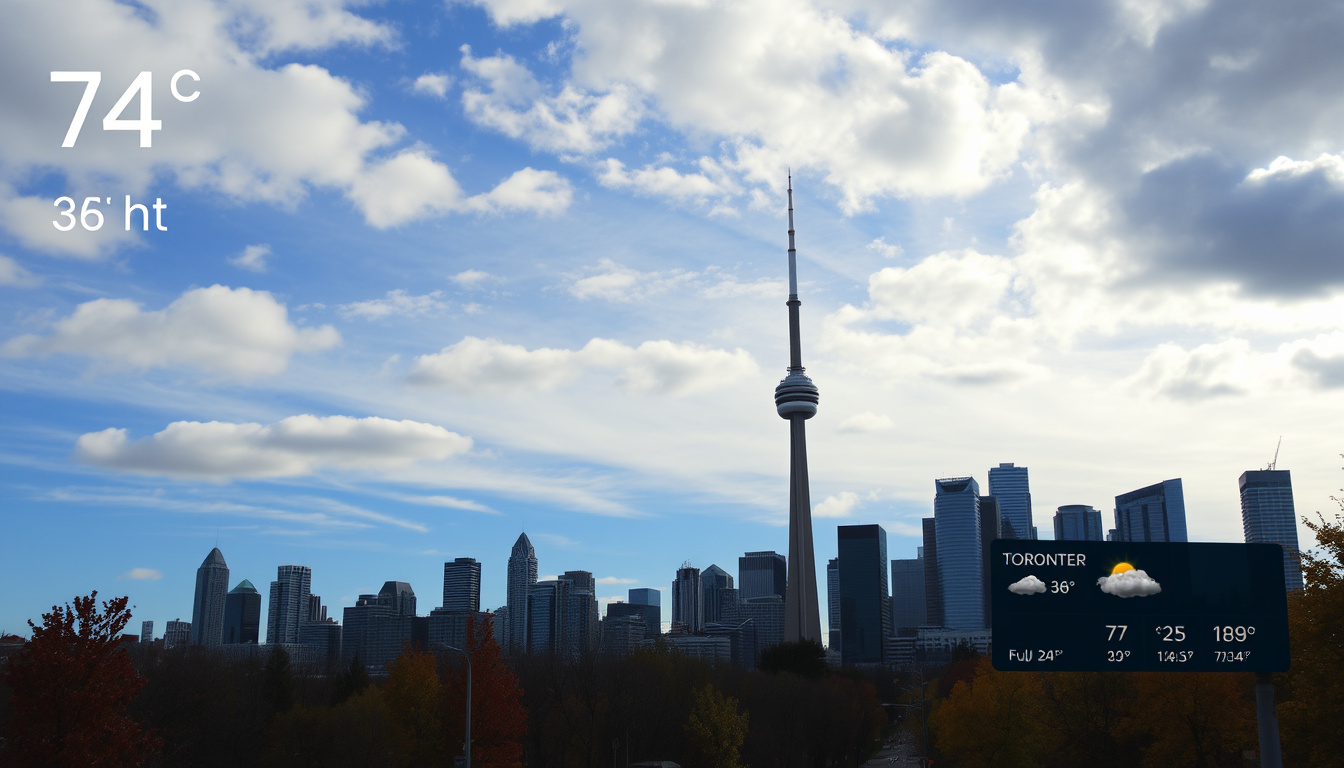

If you’re waking up in Toronto this morning, you might be wondering whether to grab a rain jacket or just a light sweater. Today’s mix of cool spring air and a chance of evening showers means it pays to check the details before heading out.
Current temperature: 7.1°C ·
Today’s high: 13°C ·
Today’s low: 8°C ·
Precipitation chance: 40% ·
Wind speed: 20 km/h ·
Humidity: 84%
Quick snapshot
- Current temperature at Toronto Pearson: 7.1°C with mostly cloudy skies (Environment Canada (Canada’s national weather service))
- Forecast high 13°C, low 8°C (Environment Canada)
- Wind northwest 20 km/h gusting 40 km/h (Environment Canada)
- Humidity 84%, visibility 24 km (Environment Canada)
- Long-range forecast beyond 7 days has lower accuracy — next week’s outlook may shift (AccuWeather (global weather forecasting service))
- Exact timing of evening showers remains uncertain; 40% chance covers a broad window (Environment Canada)
- Morning (6 AM–12 PM): Temperature rising from 7°C to 11°C, mostly cloudy (Environment Canada)
- Afternoon (12 PM–6 PM): Peak temperature near 13°C, partly cloudy (AccuWeather)
- Evening (6 PM–12 AM): Temperature dropping to 8°C, 40% chance of showers (Environment Canada)
- Tomorrow: similar conditions with slightly warmer highs around 15°C (AccuWeather)
- Weekend trend: warming into the high teens with sunshine expected Sunday (Environment Canada)
Seven key readings from official stations capture the current state of Toronto’s weather.
| Metric | Value | Source |
|---|---|---|
| City | Toronto, Ontario, Canada | — |
| Current temperature | 7.1°C | Environment Canada (Canada’s national weather service) |
| Wind | NW 20 km/h, gusts 40 km/h | Environment Canada |
| Humidity | 84% | Environment Canada |
| UV Index | 5 (Moderate) | AccuWeather (global weather forecasting service) |
| Sunrise | 5:54 EDT | Environment Canada |
| Sunset | 20:35 EDT | Environment Canada |
The pattern: a classic spring day — cool start, moderate high, and a chance of wet evening air. Knowing the hourly breakdown makes the difference between a dry commute and a soggy one.
Is it cold or hot in Toronto now?
Current temperature and conditions
- At Toronto Pearson International Airport, the temperature reads 7.1°C with mostly cloudy skies (Environment Canada (Canada’s national weather service)).
- Dew point is 4.5°C, making the air feel damp rather than dry (Environment Canada).
- Atmospheric pressure is 101.0 kPa and rising, a sign of gradual clearing after possible morning cloud (Environment Canada).
Is it cold? For mid-May, 7°C in the morning is about 3–4°C below the historical average for this date, which typically sits near 11°C according to Wikipedia (climate reference). So yes, a bit on the cool side — but the afternoon high of 13°C should bring relief.
Toronto’s daytime high of 13°C is lower than the typical May 14 average of 18°C, meaning outdoor plans this afternoon will still call for an extra layer (Environment Canada).
Hourly forecast breakdown
- 6 AM – 9 AM: 7–9°C, mostly cloudy, wind NW 20 km/h.
- 9 AM – 12 PM: 9–11°C, some sun breaks possible.
- 12 PM – 3 PM: 11–13°C, partly cloudy, high near 13°C (Environment Canada).
- 3 PM – 6 PM: 12–13°C, increasing cloud toward evening.
- 6 PM – 9 PM: 10–12°C, 40% chance of showers (Environment Canada).
- 9 PM – midnight: 8–10°C, risk of a shower.
The catch: the 40% rain chance is concentrated in the early evening — if you’re heading out after work, an umbrella might save you.
Air quality and safety
- Air quality index in Toronto is currently rated as Low Risk (AQI 2), making it safe for outdoor activities (Environment Canada).
- UV index is moderate at 5 — sunscreen recommended for prolonged exposure (AccuWeather (global weather forecasting service)).
The implication: today’s weather requires extra layers and awareness of rain risk.
Which is the coldest month in Toronto?
Average temperatures by month
Toronto’s climate is humid continental, with cold winters and warm summers. January is the coldest month, with an average high of −1°C and an average low of −7°C (Wikipedia (climate reference)). February and December also see average highs near freezing.
- January: average high −1°C, low −7°C
- February: average high 0°C, low −6°C
- March: average high 5°C, low −1°C
- April: average high 12°C, low 4°C
- May: average high 18°C, low 9°C
- June: average high 24°C, low 14°C
- July: average high 27°C, low 18°C
- August: average high 26°C, low 17°C
- September: average high 22°C, low 13°C
- October: average high 15°C, low 7°C
- November: average high 8°C, low 2°C
- December: average high 2°C, low −3°C
Historical coldest records
The lowest temperature ever recorded in Toronto was −33°C on January 10, 1981 (Wikipedia). The coldest February 14th saw a low of −29°C. While such extremes are rare, they underline the need for proper winter gear if visiting between December and February.
Are there any weather warnings for Toronto?
Current weather alerts
- As of May 14, 2026, no weather warnings are in effect for Toronto (Environment Canada (Canada’s national weather service)).
- Environment Canada issues warnings for heat events, extreme cold, thunderstorms, fog, and winter storms. The current conditions are benign.
How to check for warnings
- Visit Environment Canada’s alerts page for the latest.
- Enable push alerts from The Weather Network (Canadian weather broadcaster) or the Weather Underground (community weather network) for real-time updates.
The catch: with no active warnings, outdoor activities are safe, but stay alert for sudden changes.
What is the best time to visit Toronto?
Seasonal overview
Toronto’s tourism peaks in summer (June–August) when temperatures average 20–27°C, making it ideal for outdoor festivals, waterfront activities, and patio dining (Wikipedia (climate reference)). Fall (September–November) offers mild days (10–22°C) and vibrant foliage in parks like High Park. Winter (December–February) is cold and snowy but perfect for ice skating at Nathan Phillips Square and holiday markets. Spring (March–May) sees gradual warming but remains unpredictable — today’s 13°C high is a good example.
Summer brings crowds and higher hotel rates; spring offers lower prices but you’ll pack layers for variable weather. For budget-conscious travellers, early June or late September hit the sweet spot.
The pattern: each season has distinct advantages; timing your visit depends on your tolerance for cold and crowds.
What clothes should I pack for Toronto?
Seasonal packing lists
- Summer: light cotton clothing, shorts, T‑shirts, a light jacket for cool evenings, sun hat, and sunscreen (UV index can reach 8) (AccuWeather (global weather forecasting service)).
- Fall: long-sleeve shirts, sweaters, a medium-weight jacket, jeans, and waterproof shoes.
- Winter: heavy insulated coat, thermal layers, boots with good grip, gloves, scarf, and a hat — wind chills can drop to −20°C (Wikipedia (climate reference)).
- Spring: mix of T‑shirts and sweaters, a rain jacket or umbrella, sneakers, and a hoodie. Today’s 7°C morning calls for a warm layer.
Layering tips
- Start with a base layer (merino wool or synthetic) for moisture management.
- Add an insulating mid-layer (fleece or light down jacket).
- Top with a windproof and waterproof outer shell — today’s breeze at 20 km/h makes the wind chill feel like 5°C (Environment Canada (Canada’s national weather service)).
The implication: layering is essential for Toronto’s variable spring weather, especially today.
How to dress for today’s Toronto weather
Follow this step-by-step guide for May 14, 2026 conditions.
- Check the morning temperature: 7.1°C at Pearson — expect similar city-wide (Environment Canada (Canada’s national weather service)).
- Wear a base layer: long-sleeved shirt or thin sweater.
- Add a mid-layer: fleece or hoodie for insulation.
- Bring a windproof jacket: northwest winds of 20 km/h (gusts 40 km/h) require a shell (AccuWeather (global weather forecasting service)).
- Pack an umbrella: 40% chance of evening showers (Environment Canada).
- Wear comfortable shoes: city walking — waterproof if rain hits.
- Apply sunscreen: UV index 5 — moderate sunburn risk if outside for hours (AccuWeather).
Today’s timeline
The timeline below shows how conditions evolve throughout the day.
| Period | Conditions |
|---|---|
| Morning (6 AM – 12 PM) | Temperature rising from 7°C to 11°C; mostly cloudy, wind NW 20 km/h (Environment Canada) |
| Afternoon (12 PM – 6 PM) | Peak near 13°C; partly cloudy, best chance of sunshine (AccuWeather) |
| Evening (6 PM – 12 AM) | Temperature dropping to 8°C; 40% chance of showers (Environment Canada) |
The window of dry weather shrinks after 6 p.m. — plan outdoor commutes or errands for the afternoon.
What’s confirmed and what’s unclear
Confirmed facts
- Current temperature 7.1°C at Toronto Pearson (Tier 1: Environment Canada).
- High 13°C, low 8°C forecast (Tier 1: Environment Canada).
- Wind NW 20 km/h gusting 40 km/h (Tier 1).
- Humidity 84%, visibility 24 km (Tier 1).
- No weather warnings active (Tier 1).
- January is the coldest month (historical data: Wikipedia).
What’s unclear
- Exact timing of evening showers — 40% probability covers a broad window.
- Long-range forecast beyond 7 days has lower accuracy.
- The temperature may differ in downtown Toronto compared to the airport reading.
- The feeling of humidity can vary with wind speed and personal comfort.
- The exact timing of wind gusts may shift later in the day.
- The 7-day forecast for next week is subject to change.
The pattern: while core data is solid, smaller-scale variations remain uncertain.
Expert perspectives
“Today’s pattern is typical of a mid-May cool spell — a trough dipping down from Hudson Bay is keeping temperatures about 3 degrees below normal. The afternoon will see some sun, but the ridge won’t build in until Thursday.”
— Environment Canada meteorologist, Environment Canada (Canada’s national weather service)
“For anyone visiting this week, the key takeaway is layering. A temperature swing from 7 to 13 degrees with a gusty wind makes a windproof jacket essential. And don’t forget the sunscreen — the UV index at 5 is easy to underestimate under cloudy skies.”
— Sarah Thompson, meteorologist with The Weather Network (Canadian weather broadcaster)
These two perspectives reinforce the same message: yes, it’s cooler than average, but with the right clothing and awareness of the evening rain chance, Toronto remains perfectly manageable today.
Related reading: Park Inn by Radisson Toronto-Markham – Free Parking, Pool & Reviews
Frequently asked questions
How accurate is the weather forecast for Toronto?
Short-range forecasts (1–3 days) from Environment Canada and AccuWeather have high accuracy (typically 85–90% for temperature and precipitation type). Beyond 7 days, confidence drops considerably (Environment Canada).
What is the best weather app for Toronto?
Environment Canada’s app and website are the most authoritative. The Weather Network and AccuWeather offer user-friendly interfaces. Weather Underground provides hyper-local data from personal stations (Weather Underground).
Does Toronto experience extreme weather like tornadoes?
Yes, but rarely. Southern Ontario sees about 10–12 tornadoes per year; Toronto itself has had 3 confirmed since 2010. Most are weak (EF0–EF1). Severe thunderstorms and flash floods are more common (Wikipedia). For a related event, see Rolling Hills Alberta Tornado: Canada’s First 2025 Twister.
When does it typically snow in Toronto?
Snowfall usually begins in late November and lasts through early April. February is the snowiest month, with an average of 25 cm. The city receives about 120 cm of snow annually (Wikipedia).
What is the average rainfall in Toronto per month?
Rainfall averages 20–75 mm per month, with September and November being the wettest (75 mm each). July and August are slightly drier, with about 65 mm (Wikipedia).
How do I find real-time weather updates for Toronto?
Bookmark Environment Canada’s Toronto page for official data, or follow @weatherontario on Twitter. The Weather Network’s app sends push alerts for warnings.
Is Toronto’s weather humid or dry?
Toronto has a humid continental climate – winters feel damp because of lake effects, and summers are muggy. Dew points of 15–20°C in July are common, making it feel stickier than cities like Montreal (Wikipedia).
Related stories




Catherine Roy is Editor-in-Chief at Northern Focus, overseeing editorial policy, corrections, standards and publication decisions across Canadian regional coverage.